


by Jakob Shaw, Rhode Island Current
February 25, 2026
Rhode Island lawmakers are considering H7334, a bill sponsored by Rep. Megan Cotter, an Exeter Democrat, that would prohibit pet stores from selling parrots sourced from breeders and animal brokers. This legislation is an important step toward reducing the number of parrots suffering in captivity. But before we talk about businesses or supply chains, we should talk about the parrots.
Parrots are inquisitive, social animals who form deep, lasting bonds. In nature, they rarely spend a moment alone: they spend hours each day foraging for food with their flock mates, soaring through the sky and exploring their habitats — which, depending on the species, can range from lush rainforests to sprawling grasslands and open plains. Flying isn’t just something they do; it’s essential to who they are. Whether they’re perched in treetops or flying through the open air, parrots call out to one another in constant conversation. Ornithologists studying the Green-rumped Parrotlet have discovered that parrots not only have their own names, which they learn from their parents, but that they’re able to both learn and use the names of other parrots to communicate with each other.
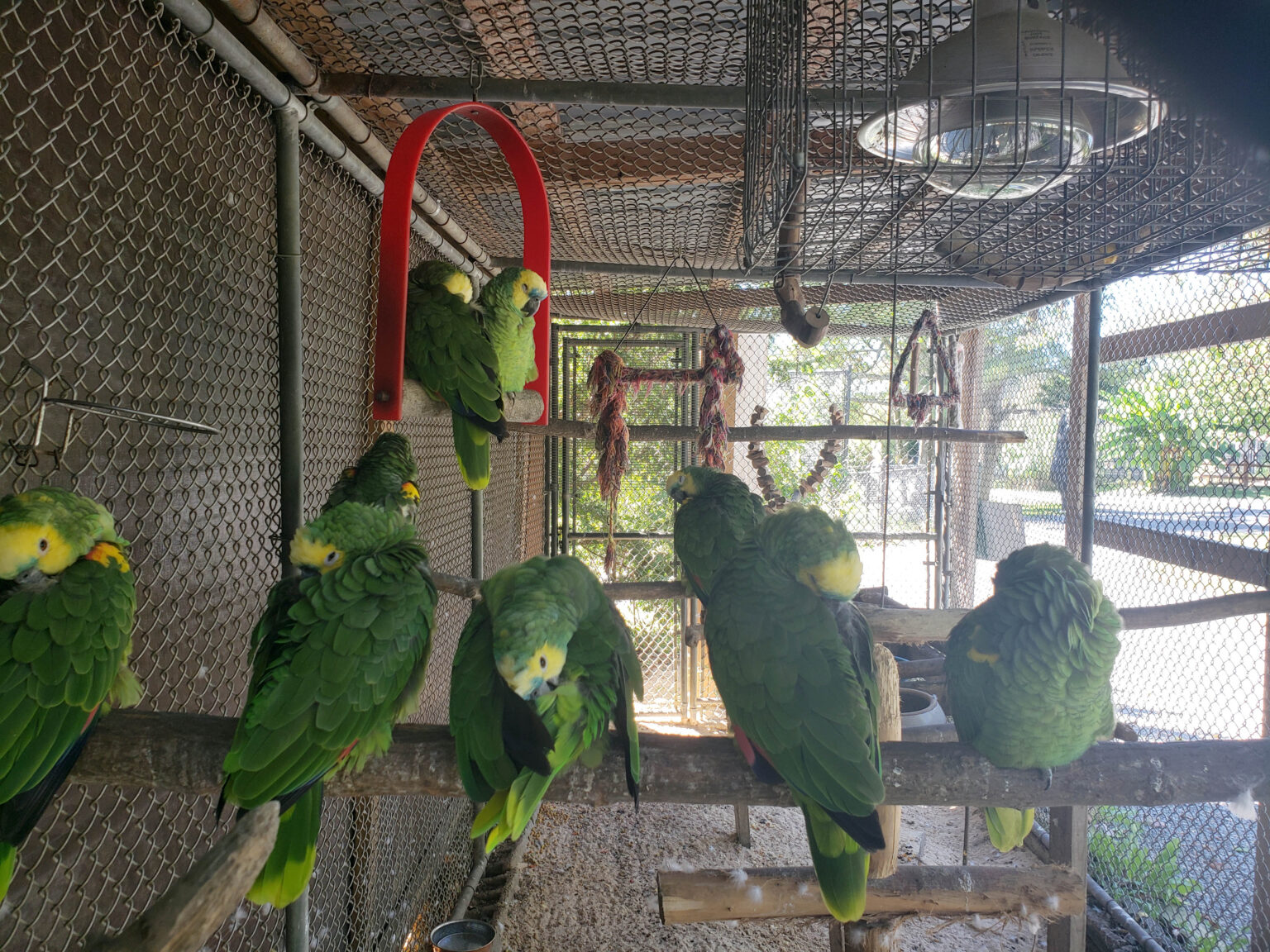
Now picture these profoundly social parrots, alone, locked inside metal cages — for 30, 40, or even 50 years.
Captivity strips away everything that gives their lives meaning and purpose. Many have their wings clipped so they cannot fly at all. Some scream for hours. Others rock or pace. Many pull out their own feathers. Veterinary experts estimate that as many as 25% of captive parrots engage in self-harm, a stress-induced behavioral problem that is not observed in wild parrots. It is a direct result of their being kept in captivity.
Around the country, millions of parrots are kept as “pets,” which means they spend their lives locked in cages. Even when families begin with the best intentions, many underestimate the extraordinary commitment parrots require — decades of daily interaction, constant cleaning, specialized veterinary care, and significant expense. As reality sets in, guardians unable to meet these birds’ complex needs surrender thousands to rescues and sanctuaries every year.
Rhode Island sees the consequences up close. Foster Parrots, New England’s largest avian rescue organization, receives hundreds of requests annually to take in parrots. Some rescues are still caring for parrots who entered the trade decades ago, with one director noting, “We’re still dealing with birds that were bred in the ’70s and ’80s—they’re still in the system.”
All of this — combined with parrots’ 20- to 80-year lifespan — has created a nationwide crisis of unwanted parrots. For every parrot purchased from a store, another remains homeless.
And yet, breeders continue to produce more.
Supporters of retail avian sales argue that licensed breeders follow federal standards under the Animal Welfare Act — but federal licensing does next to nothing to guarantee humane care. Virtually all birds sold in retail stores come from large‑scale commercial breeding facilities, and investigations have shown that these operations routinely fail to meet even basic welfare requirements. A recent investigation documented appalling conditions at several USDA-licensed breeding facilities that supply the retail market. Investigators found thousands of birds crowded into filthy cages, and dead birds piled in trash bins. One parrot breeder admitted to the investigator that he killed parrots who couldn’t be sold by suffocating them in a plastic bag — a terrifying way to die. These operations were licensed, regulated, and operating largely “in compliance.”
For every parrot purchased from a store, another remains homeless. And yet, breeders continue to produce more.
This bill would help to cut off the pipeline of parrots being churned out at abusive large-scale breeding facilities and sold into a lifetime in captivity, likely to be defined by isolation, deprivation, and distress.
If you walked into a neighbor’s home and saw a bald eagle behind bars, you would recoil. We all would. We instinctively understand that an animal built to soar cannot thrive in a cage. Parrots are no different; we’ve simply grown accustomed to seeing them confined.
Birds are not décor. They are not retail inventory. They are animals who need flight, companionship, and community. A cage — no matter how clean or how big — cannot replace freedom.
Rhode Island has an opportunity to lead with compassion. We cannot give every caged parrot back to the sky. But we can stop breeding more into lives without it.
GET THE MORNING HEADLINES.
Rhode Island Current is part of States Newsroom, a nonprofit news network supported by grants and a coalition of donors as a 501c(3) public charity. Rhode Island Current maintains editorial independence. Contact Editor Janine L. Weisman for questions: [email protected].