


4 April 2026
This story was originally published by The New Humanitarian.
By Kristen Hope
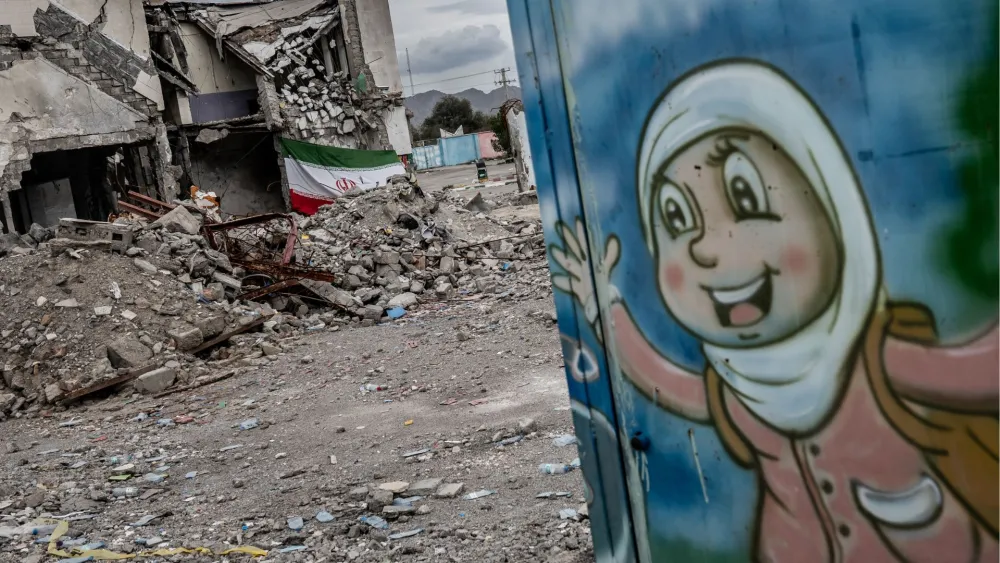
In contrast to the silence of many world leaders following the US missile strike on an Iranian school that killed over 160 girls, child rights organisations and advocates have denounced the Minab school massacre.
The UN Committee on the Rights of the Child issued a statement: “Children must never be collateral damage.” War Child declared: “The law is clear: civilians and children are entitled to special protection in times of war. Children – and the places they live, learn, heal, and play – must never be targeted.” More recently, former UK prime minister Gordon Brown repeated the same line: “No child should ever become collateral damage in a conflict.”
In my 15 years working in research and advocacy in the international child protection sector, I have often held the pen that drafted statements like these. And I mean it with no disrespect to the people behind them when I say this grammar is no longer adequate for the world we are living in.
The normative trap
There is a pattern in how child-focused civil society bodies respond to atrocities involving children in war. It moves between description and prescription; between naming what has happened and asserting what should not have. Children should never be collateral damage. Schools must never be targeted. International humanitarian law must be upheld. The problem is not that these norms are irrelevant. The problem is what this grammar cannot say, particularly considering that long-held assumptions about the international “rules-based order” are increasingly recognised as failing to safeguard the well-being of humanity.
For child-focused advocates to continue repeating the mantra of international conventions and norms against targeting children is to ignore a core logic of contemporary imperial warfare: the systematic dehumanisation of children in the majority world. We are witnessing livestreamed conflict governed not by the principles of international law, but by the logics of racial capitalism, understood as a system where race determines who gets exploited and dispossessed.
In wars waged by racist right-wing leaders, children are not mere collateral damage – they are targets, because they represent the possibility of a future that exists beyond ethnocentric, imperialist hegemony.
As American abolitionist and prison scholar Ruth Wilson Gilmore reminds us, the exposure of non-white lives to premature death is a defining feature of racial capitalism. Recognising this gives us the structural frame to read the mass killing of children in Minab and in Gaza differently. In wars waged by racist right-wing leaders, children are not mere collateral damage – they are targets, because they represent the possibility of a future that exists beyond ethnocentric, imperialist hegemony.
This is what Palestinian scholar Nadera Shalhoub-Kevorkian captures in her concept of the “politics of unchilding”: the ways in which colonial and settler-colonial regimes strip certain children of their childhood, rendering them threats rather than victims, legitimate targets rather than rights-holders. That is not a marginal academic observation. Less than a year ago, Israeli politician Moshe Feiglin openly declared: “every child, every baby in Gaza is an enemy”. After two and a half years of Israel’s genocidal campaign in Gaza, more than 18,000 children have been killed in Gaza and hundreds more in the West Bank. No mechanism of international law has been able to stop it, or to hold Israel accountable.
Is it, then, still possible to claim that the destruction of children’s lives in war is an aberration? In certain conflict zones today, children are not incidentally caught in crossfire – their lives are deliberately dislocated and erased. The United Nations has documented 1,205 cases of Ukrainian children kidnapped and deported by Russia. In southern Lebanon in 2024, more than 200 children were killed and over 100 schools were demolished and vandalised by the Israeli army.
In wars waged by superpowers and their allies, crimes against children persist with impunity, which allows atrocities like Minab to continue to happen. So, while child-focused advocates might all agree that children “shouldn’t” be targets, our grammar fails us by foreclosing the possibility of thinking about the implications of recognising that they are, and that the international system designed to protect them is blatantly powerless.
Set against the outpouring of grief that would have met equivalent deaths in a European city, the muted response to the killing of Iranian girls is not a failure of empathy. It is racial capitalism functioning as designed. And when child rights organisations reach for the language of universal norms without calling out this structure, they risk rendering it invisible. The grammar of universal child rights floats free of – and masks – the political economy that determines, in practice, whose childhood is protected and whose is not; which children are permitted to live and which ones are destined to die in the name of racialised narratives of “freedom” and “peace” while exponential profits and territorial expansion go unchecked.
The lens of racial capitalism lets us see that the killing of children is not an anomaly, but rather is structurally produced by global power systems – from arms trade to border regimes – which simultaneously erode the very institutions meant to deliver accountability.
What would it mean to say what is?
The sooner that advocates of international law and human rights are bold enough to connect these dots, the sooner we might find ways to move beyond our frustrations with the status quo. Attending honestly to the ways in which racial capitalism structures the terms of modern conflict and limits humanitarian action may be precisely what is needed to move beyond this impasse.
The grammar of child rights advocacy in war needs to change. It needs to resist the comfort of normative statements about how things should be, and sit longer in the descriptive and the analytical – with what is actually happening to children, and why.
That would be perhaps a starting point for imagining a mode of humanitarian thinking and action that refuses to accept the political conditions that produce the crises it responds to, rather than working within them. It asks what humanitarian action might look like if it started from an honest account of power, rather than from the assumption that international norms, properly applied, will eventually hold.
The grammar of child rights advocacy in war needs to change. It needs to resist the comfort of normative statements about how things should be, and sit longer in the descriptive and the analytical – with what is actually happening to children, and why. Changing semantics also alters the horizon of possible actions. Child-focused humanitarian actors might find themselves learning from critical legal and decolonial scholars and anti-capitalist, anti-racist activists.
In the process, this might open up spaces for collectively considering what “could be”: principles, provisions, and mechanisms for protecting children in conflict that are fit for the ways in which racial capitalism shapes 21st century warfare. It could also yield consideration of more creative and disruptive forms of influencing, such as consumer boycotts or community organising – ideas that go beyond penning words of condemnation on a page. As the world spirals deeper into the chaos of imperial warfare, child-focused advocates must find the language to enable resistance.
–––––
The New Humanitarian puts quality, independent journalism at the service of the millions of people affected by humanitarian crises around the world. Find out more at www.thenewhumanitarian.org.