


By:

NADIN ELSIR July 21, 2026

On a rough field inside Kiryandongo refugee settlement, displaced women are building a volleyball community that gives girls room to compete, form friendships and recover a sense of agency after war.
The piece of land did not look like a volleyball court.
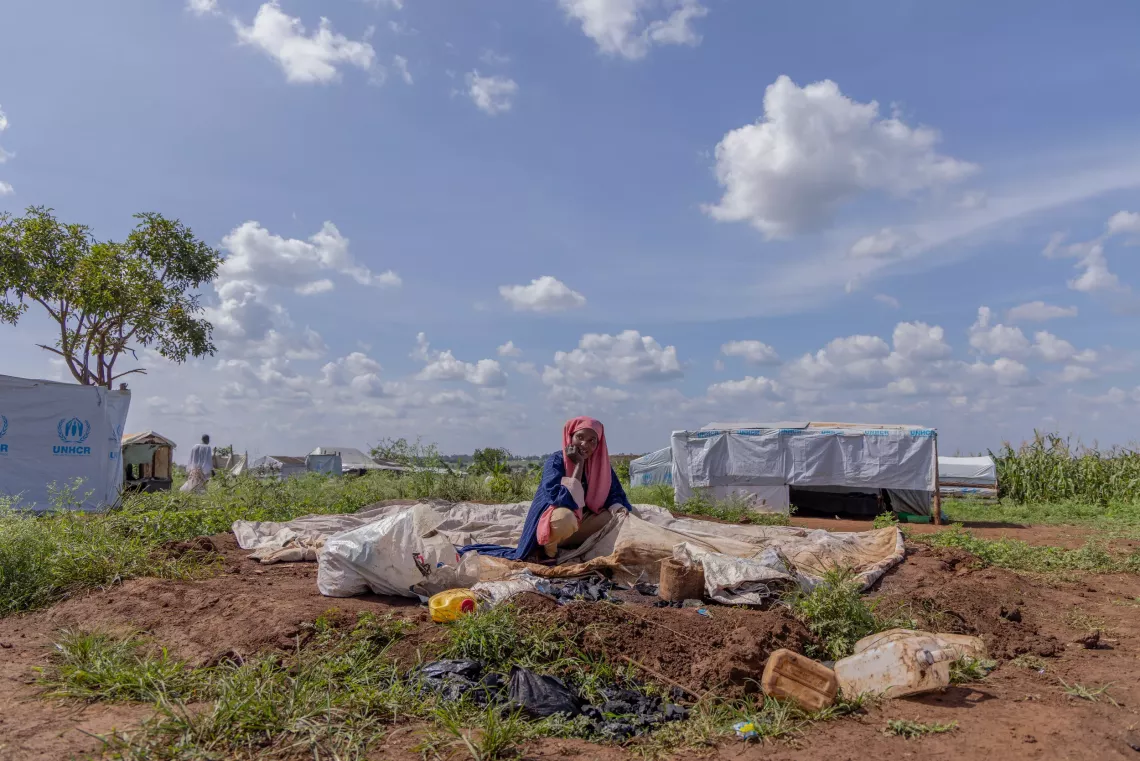
Wild grass covered parts of the ground, stones were scattered across its surface, and there were no boundary lines or net between the two poles. To many people, it was simply an unused area inside Uganda’s Kiryandongo refugee settlement. But to Zahra Issa, a former Sudanese volleyball player who fled the war and later began coaching girls in the settlement, it represented the future home of a team.
Standing before a group of girls, she pointed towards the open space and said, “This will be our court.”
That moment marked the beginning of a women’s volleyball team built not on resources, but on the determination of women who needed a place to gather, move and reconnect with life after war and displacement.

Kiryandongo refugee settlement, about 220 kilometres north of Uganda’s capital, Kampala, is home to refugees from across the region, including thousands of Sudanese who fled the war that erupted in April 2023. Families live in scattered clusters across the settlement, rebuilding their lives with limited resources.
For many women and girls, opportunities to gather outside their homes are rare. The volleyball court has therefore become more than a place to play sport. It is one of the few spaces where they can meet, support one another and reclaim a sense of normality.
Zahra understood the power of volleyball long before she arrived in Kiryandongo. She had played for Al-Majd Club in Omdurman and Al-Khartoum Al-Watani Club in Sudan, and studied at the Sudan University of Science and Technology. Born to a South Sudanese mother and a Sudanese father, she grew up navigating two identities, an experience that shaped her belief that differences could become a bridge rather than a barrier.
When she arrived in Kiryandongo, she did not come with funding or a ready-made plan. She came with years of experience as a player and a conviction that volleyball could offer women and girls more than a game. It could provide a space in which they could rebuild their confidence, form friendships and begin to heal from displacement.
The initiative began in early 2025 in the settlement’s reception area. Volleyball activities already existed there, but they were irregular and involved both men and women. Zahra noticed that girls were eager to play but lacked a space designed for them. She began with eight players.
The first challenge was not teaching them volleyball skills. It was persuading families to allow their daughters to participate.
Zahra visited households, spoke with parents and explained that sport could help girls develop confidence, discipline and emotional strength during a difficult period in their lives.
“The first thing I had to build was not the team, but trust,” Zahra says. “I visited families and spoke with them because I wanted them to understand that these girls were not wasting their time. They needed a space where they could learn, connect with others and feel confident again.” That trust became the foundation on which the team was built.
As refugees moved from the reception area to different clusters in the settlement, the training sessions moved with them. Zahra continued organising practices despite limited equipment and difficult playing conditions. Slowly, the group of eight players grew into a wider community.
Coach Wael Marhoom witnessed the transformation from the beginning. He remembers that volleyball activities had existed in the reception area before Zahra formed the team, but they had not been formally organised.
A major turning point came when a women’s tournament was organised among four teams in Cluster K. More than 30 girls from different age groups participated, revealing a strong desire among refugee women and girls to form a team of their own.
For Wael, one of the greatest challenges was not simply the shortage of equipment and other resources. It was establishing trust among coaches, players and families in a settlement where many people were still living with the uncertainty of displacement.
“The hardest stage was building trust between the coaches, the players and their families, especially because of the security situation inside the settlement,” Wael says. “But the girls’ determination and their commitment to training gave us the motivation to continue.”
Over time, he watched the court become more than a place for training and competition.
“I strongly believe that sport is one of the best ways to build peace,” he says. “Through volleyball, we saw relationships change. Girls from different backgrounds started playing together.”
As those relationships developed, the team became a shared space for women and girls whose backgrounds might otherwise have kept them apart.
The team later received support from Waei, a feminist community initiative that subsequently became the Waei Organisation. Its role was not to establish the team, but to strengthen an effort already being led by Zahra and the players. Waei created opportunities for the team through visits, friendly matches and tournaments.
In 2025, the organisation hosted two women’s volleyball tournaments at its headquarters in Kampala, giving the Kiryandongo players an opportunity to compete outside the settlement. Friendly matches among teams, including Waei and Al-Tadamun, continued to strengthen connections between the players. The most recent match took place in June 2026.
For the women, these games were more than competitions. They were moments in which they could see themselves as athletes, rather than only as displaced people.
The team has also benefited from the commitment of volunteer coaches. Coach Sami continued supporting training in Kiryandongo alongside Zahra and Wael, while Coach Jad Al-Rab Abdulqader travelled from Kampala to help the players develop their technical skills.

Jad’s connection with the team began unexpectedly. During a visit to Kiryandongo, he noticed a girl carrying a volleyball and rushing because she was afraid of missing training. Curious, he followed her and found Zahra coaching a group of players on a difficult field. What impressed him was not only their ability, but also their dedication.
A former Al-Majd Club player and a certified volleyball coach who has worked with schools and universities, Jad decided to support the team voluntarily. He has since trained the players without financial compensation because he believes their commitment deserves support.
For Jad, volleyball represents more than competition. It is a sport built on communication, balance and respect. He believes it is particularly valuable in creating safe spaces for women because it encourages cooperation and connection.
The impact of the team is reflected most clearly in the stories of its players.
Isra Abkar Mohamed arrived in Kiryandongo in 2024 with her aunt after fleeing Sudan. As a secondary school student carrying the emotional weight of war and displacement, she found in volleyball a place where she could connect with people her own age and begin to imagine a future again.
“It was the first day I felt there was hope that I could live my youth,” Isra says.
Her decision to play created conflict within her family. At one point, she left home to attend training despite her family’s opposition. Later, when she became separated from them, her teammates became her support system.
“After my mother expelled me from the house, volleyball became my family,” she says. For Isra, the team became a place where she learned confidence, friendship and coexistence.
Sarah Adam’s story reflects another dimension of the team’s identity. Originally from South Sudan, Sarah arrived in Uganda in 2024 after being displaced from Sudan and travelling through Juba. Before the war, she had played volleyball for Al-Halfaya Women’s Club in Sudan.
When she arrived in Kiryandongo and saw Zahra training the girls, she immediately joined them. “Volleyball changed my life. It changed my perspective on many things, especially coexistence,” Sarah says.
As the team continued to grow, another challenge became impossible to ignore: the condition of the playing field.
The players were training on an unsafe surface, many of them without proper sports shoes, and the poor condition of the ground increased the risk of injury. The court that had become their safe space needed to be made physically safer. This time, the players themselves decided to act.
Marwa, a member of a women’s volleyball team in Kampala, proposed an initiative to rehabilitate the Kiryandongo court. The idea emerged after years of exchanges among women’s volleyball communities in Uganda, including teams in Biyale, Sita and Kampala. During those visits, players shared their experiences and repeatedly raised the same concern: the lack of suitable courts.
During a visit to Kiryandongo on June 14, 2026, Marwa joined the girls’ training session and saw the condition of the court firsthand. Despite the poor surface and shortage of equipment, the players continued to train regularly because volleyball had become one of their few sources of relief and solidarity.
The rehabilitation initiative officially began on June 21, 2026. It brings together players, young athletes, community activists and the Sudanese Youth Union in Kiryandongo through its sports committee.
The first priority is to improve the court’s surface. Other needs include changing areas, sanitation facilities and equipment. The initiative currently relies on individual contributions and fundraising activities, including volleyball matches organised in Kampala to attract potential supporters.

For Marwa and the players, rebuilding the court is not only about repairing a physical space. It is also about recognising women’s right to participate in sport and creating a place where girls can gather safely, develop confidence and make their voices heard.

Today, Kiryandongo’s women’s volleyball community continues to grow. The players dream of gaining official recognition, registering with sports bodies and representing Sudan in regional competitions such as the East Africa Women’s Volleyball Championship.
What began with eight girls and a coach standing on an empty piece of land has become something much larger.
The court Zahra imagined is no longer simply a place to play volleyball. It is a place where women from different backgrounds meet, support one another and build a future that extends beyond displacement.
The above article is republished here under a Creative Commons 4.0 License. The original article is here:
Women, volleyball and Kiryandongo