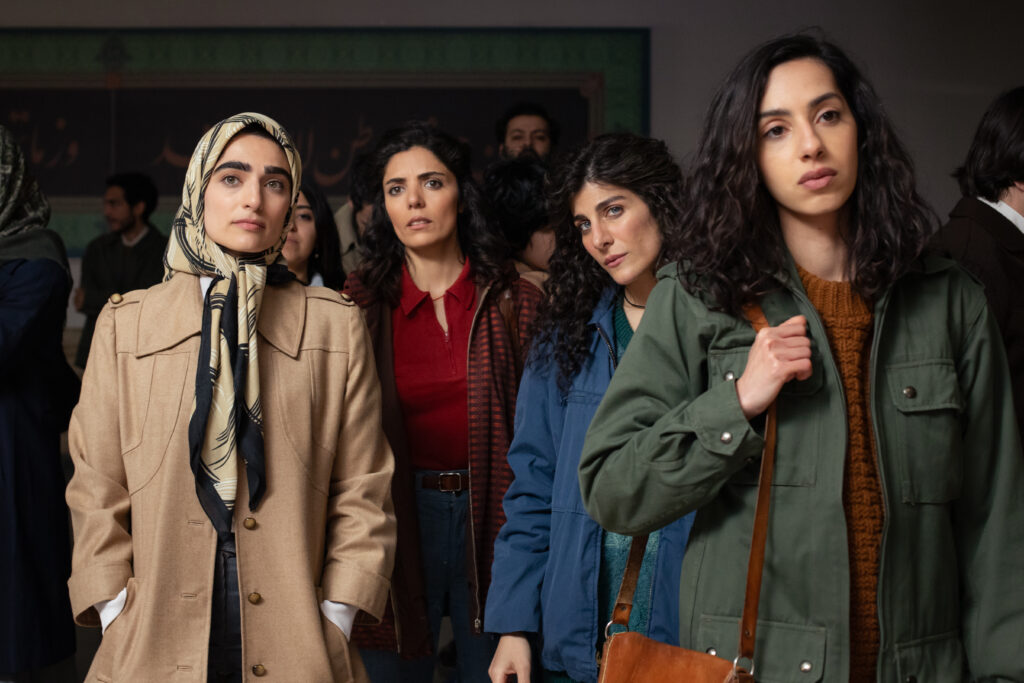
Reading Lolita in Tehran movie still from Greenwich Films
Note: All of the following material is for educational use only. Intellectual property law protects the material from unauthorized use. This material is intended to present background information on the brutality women in Iran have dealt with under the government in Iran for decades.
Reading Lolita in Tehran book cover. From Penguin Random House.
Following is a review of the book, Reading Lolita in Tehran from 12 Sep 2003 that was published in The Guardian.
Through the veil | Books | The Guardian
Reading Lolita in Tehran: A Story of Love, Books and Revolution by Azar Nafisi 347pp, IB Tauris, £14.95
After teaching literature at three universities in Tehran (and being expelled or resigning in despair from each) Azar Nafisi picked seven of her best students and invited them to come to her home every week to discuss books. She and her students, all women, began to think of these classes as an escape from the reality of Iran’s totalitarian theocracy; but the picture her book paints is of an escape to a true republic where they are all able to discover another reality – themselves.
The classes lasted from 1995 to 1997, when Nafisi left for the United States. But why Lolita? Nafisi’s choice of Nabokov as an author to study is only partly an acknowledgement of the hard, precise beauty (and sometimes difficulty) of his prose, always read in English. In her class Humbert Humbert’s seizure of his nymphet’s life and identity becomes a metaphor for the way the radical Islamic state was treating its women – not least in his recording that it was Lolita who initiated their sexual relationship, the adolescent who seduced her stepfather; it felt as though radical Islam was blaming women.
But the seven students who unexpectedly bonded at Nafisi’s home also responded enthusiastically to Nabokov’s other work and particularly to his use of the Russian word poshlust. She quotes him: “It is not only the obviously trashy but mainly the falsely important, the falsely beautiful, the falsely attractive.” These qualities linking the banal and the brutal are not exclusive to totalitarian society nor even the 20th century, but they have thrived happily in Stalinist Russia, Nazi Germany and now the priestly dictatorships too.
This book is not a political or even ethical analysis. It is taken for granted that the accusation that personal freedoms are a bourgeois and decadent concept is condescending and stupid; the problem of societies where historically only the privileged have had such freedoms is not addressed.
Although Nafisi’s classes start with Shahrazad and the Thousand and One Nights, the book concentrates on the western literature that has been her academic subject; references to the great Persian tradition are few, and all the more frustrating because they can be so telling.
This is a highly personal memoir combined with literary criticism, but even that description needs qualifying. The students whose developing stories are part of its pleasure have been disguised for their own protection. Moreover, in a manner redolent of the Persian tradition, she refers throughout to one confidant simply as “my magician”, conveying a near-mystical sense that he is a presiding genie in her life. This may be less than objective but it releases a story that is vivid, often heroic and sometimes funny in a ghastly way.
For instance, a friend starts to translate Ayatollah Khomenei’s writings into English, an activity which will gain favour with the regime while actually exposing it to ridicule. Nafisi quotes a section in which the country’s leader sanctions sex with animals as a way of keeping men’s appetites under control. Is it all right to eat, say, a chicken you’ve had sex with? No, but you can feed it to a near neighbour, apparently.
Meanwhile Nafisi and her family survive bombs and missiles from Iraq (supported by the west), and having been expelled from one university for not wearing the veil, she is persuaded by a benevolent pragmatist to adopt it so she can work in another university, on the basis that some intellectual life is better than none; but eventually she is driven out of that one too.
The charismatic passion in the book is not simply for literature itself but for the kind of inspirational teaching of it which helps students to teach themselves by applying their own intelligence and emotions to what they are reading. When the group reads F Scott Fitzgerald, for instance, there are plenty of puritanical students to argue that The Great Gatsby is a poor role model. Following the fashion of the time and place, she encourages them to put the book on trial. There are speeches for the prosecution and defence, but the only witness is the book itself – and she plays the book. She closes the class before a vote is taken, but not before the dialogue has demonstrated both the positive value of the book and the pointlessness of analysing it in terms of role models.
Perhaps the most moving section relates to Henry James’s Daisy Miller, whose heroine – in telling an emotionally reticent admirer not to be afraid – embraces her own difference and fate. It is with Daisy, in the end, that her students most identify and Nafisi’s rather wonderful book touches a beauty of its own.
Paul Allen’s biography Alan Ayckbourn: Grinning at the Edge is published by Methuen.
The above article is republished here from the original article at: Through the veil
Behind the scenes still image at Reading Lolita in Tehran
A film adaptation of Azar Nafisi’s critically praised, worldwide bestselling memoir,Reading Lolita in Tehran, is now in theatres.
The film, directed by Eran Riklis, follows a group of women meeting clandestinely in revolutionary Iran during the mid-1990s, to read forbidden books. Gathering in Nafisi’s home, they read Western classics, such as Madame Bovary, The Great Gatsby, Pride and Prejudice, and Lolita.
Education had become dangerous and even deadly during the Islamic Revolution, and reading forbidden books, Nafisi said, was a way to fight back.
The film begins with Nafisi as a university professor and ends with her exiled from her homeland. More than two decades after publishing her memoir, Nafisi told NPR’s Scott Simon about how she felt seeing her story depicted on the big screen.
“I feel towards it the way I feel towards my children,” she said.
The film won the the Audience Award and a special jury prize at the 2024 Rome Film Festival. It stars Iranian actors Golshifteh Farahani, Zar Amir Ebrahimi and Mina Kavani — all of whom, like the author, are exiles from Iran.
Movie still from Reading Lolita in Tehran
Nafisi was delighted to see her students portrayed on the screen. Remembering them now, she saw anew the power of great literature — how it brought together women from diverse backgrounds to her living room every week.
“These girls were very different, one from the other,” Nafisi said of the students who studied with her in Tehran. “Outside the classroom, they probably wouldn’t talk to one another. But in that class, they learned to communicate and to connect.”
Through the stories they read, Nafisi said each could find herself — and become more herself. “It reached a sort of magic,” she said.
Nafisi says that kind of magic was shattered by a government that was determined to silence dissent. Nafisi’s homeland changed quickly into a place she barely recognized.
“This wasn’t my land,” she said. “This was a country ruled by a regime that stoned people to death.”
When the religious hardliners in the government banned women from appearing in public without a headscarf, the film shows Nafisi, played by Golshifteh Farahani, agonizing in front of a mirror with a black headscarf.
“The expression on her face is fear, because by and by, she disappears into this garment,” Nafisi said.
For some, the headscarf was a symbol of women’s place in society. But for Nafisi, it represented an existential threat.
“This is not a political fight. This is an existential one,” she said. “Our identity as human beings, as women, has been taken away from us.”
When her resistance to covering her hair became too dangerous, Nafisi says she found small ways to rebel. “I never wore my scarf properly. I would always show a few strands out of the scarf to tell them, ‘You don’t own me.’ “
Nafisi’s 2003 memoir about fighting the Iranian Revolution through the simple act of reading was an international bestseller, won numerous literary awards, and was named as one of the “100 Best Books of the Decade” by The Times(London).
Nafisi now lives in Washington, D.C., and continues to advocate for the role of artists and writers in society.
She shared with Simon an illustrative story from the beginning of the Islamic Revolution. The new leaders had torn down the statues of the king and the royal family and changed the names of streets. But when they tried to bring down the statue of Persian poet Abul-Qâsem Ferdowsi and erase his place of honor within the culture, the people pushed back.
“I thought, how fantastic that they can bring down the statue of the Shah, but they can’t touch the poet,” she said.
Transcript
SCOTT SIMON, HOST:
Every Thursday morning in the mid-1990s, a group of women students of Azar Nafisi would meet in her home in Tehran to read books forbidden by the Iranian regime – books from the West, including “Madame Bovary,” “The Great Gatsby,” Jane Austen and Vladimir Nabokov’s “Lolita.”
(SOUNDBITE OF FILM, “READING LOLITA IN TEHRAN”)
GOLSHIFTEH FARAHANI: (As Azar Nafisi) In the book, Humbert says straight out that what he possessed wasn’t the real Lolita but the one he imagined, his own creation, one that had no will, no life of her own.
SIMON: Azar Nafisi’s critically praised and worldwide bestselling 2003 memoir, “Reading Lolita In Tehran,” is now a movie. Directed by Eran Riklis, it won the audience award and a special jury prize at the 2024 Rome Film Festival. And Azar Nafisi, who’s gone on to author a number of other bestsellers and teaches at Johns Hopkins School of Advanced International Studies, joins us in our studios. Thanks so much for being with us.
AZAR NAFISI: Thank you for having me. It’s a pleasure to be here.
SIMON: What’s it like to see not just yourself, but your family, your life on screen?
NAFISI: It is an interesting kind of feeling because on one hand, this is not me. On the other hand, what Eran has done so well is has gotten the feel of the experience of being there in Tehran at that time. And so I get the feel of it. That becomes familiar.
SIMON: What did the works you read with your women students at the time say to them?
NAFISI: Well, at first, for them, it was awkward. The books become a place where they all agreed on. These girls were very different, one from the other. You had one who was fiercely secular, and you had one who was fiercely Muslim. In real life, I mean, outside the classroom, they most probably wouldn’t talk to one another. But in that class, they learned to communicate and to connect. And we all, including myself, reached sort of magic in the way we, through the book, became more ourselves through becoming the others.
SIMON: The film stars several Iranian-born actors, and notably, Golshifteh Farahani, who plays you.
NAFISI: Yes.
SIMON: She lives in France now. She can’t live in Iran now. Several other actors in the film can’t live in Iran. What is it like to be banned from your homeland?
NAFISI: You know, you can’t digest it at first. It takes a while to understand what this means, to be banned, to be made invisible. And there is a scene in the movie where the character Azar is ready to leave home, and she’s standing in front of the mirror and putting her scarf and her robe on. And the expression in her face is a sort of fear because, by and by, she disappears into this garment that is from head-to-foot black. And so my feeling was that they are – this is not a political fight. This is an existential one.
SIMON: Do you miss Iran?
NAFISI: Yes. I miss the Iran that I will never find again because they changed it so much, you know? But what they couldn’t change was the soul and hearts of the people. Could I tell you an anecdote about…
SIMON: Please.
NAFISI: …This? Well, you know, at the beginning, when these guys came to power, one of the first things they did was to bring down the statues of the king and the royal family and change the name of the streets. But then they decided to bring down the statue of our epic poet Ferdowsi, whom they consider dangerous because he offers a different Iran through his epic. There, the Iranian people stood for. And I thought, how fantastic that they can bring down the statue of the shah, but they can’t touch the poet.
SIMON: How do you feel about what’s going on now – right now, this week?
NAFISI: I feel outraged. And then I remembered something my mother said. The last day I was in Tehran, she kept following me around and tell me, tell them. Tell them. And she meant tell them how, over here, they try to isolate us from the world. Tell us that the world doesn’t care about us. You tell them the truth. You reveal the truth. And I felt that that is my duty as a writer. As James Baldwin says, writers are witnesses. They don’t make judgment. They reveal truth.
I remember my father telling me, Iran is an ancient land, and it has been invaded and attacked many times. But what gives us some identity is our poetry. That is the one that has stayed with us for these thousands of years. And so that is what literature does. It becomes guardians of memory. And without it, we can’t live.
SIMON: Azar Nafisi – her 2003 book “Reading Lolita In Tehran” has been made into a film. It’s in theaters now and on several streaming platforms. Thank you so much for being with us.
Accuracy and availability of NPR transcripts may vary. Transcript text may be revised to correct errors or match updates to audio. Audio on npr.org may be edited after its original broadcast or publication. The authoritative record of NPR’s programming is the audio record.
UN experts strongly condemn death of Mahsa Amini, ‘victim of Iran’s sustained repression’
“We are shocked and deeply saddened by the death of Ms Amini,” they said in a statement.
“She is another victim of Iran’s sustained repression and systematic discrimination against women and the imposition of discriminatory dress codes that deprive women of bodily autonomy and the freedoms of opinion, expression and belief”, the experts added.
Stop lethal force
The experts also denounced violence by Iranian security forces directed against peaceful protesters and human rights defenders in cities across the country, who have been marching and demanding accountability for Ms. Amini’s death.
They urged the Iranian authorities to avoid further unnecessary violence and to immediately stop the use of lethal force in policing peaceful assemblies.
Arrest by ‘morality police’
Ms. Amini was arrested by Iran’s morality police on 13 September, and according to news reports, was badly beaten while being taken into custody, which Iranian authorities have denied, claiming instead, that she died of a heart attack.
She reportedly fell into a coma at the Vozara Detention Centre and died in hospital on Friday, 16 September.
“We strongly condemn the use of physical violence against women and the denial of fundamental human dignity when enforcing compulsory hijab policies ordained by State authorities,” the experts said.
“We call on the Iranian authorities to hold an independent, impartial, and prompt investigation into Ms Amini’s death, make the findings of the investigation public and hold all perpetrators accountable”.
Uniting for women
Since Friday, thousands have taken to the streets in cities throughout Iran – including Tehran, Ilam, Isfahan, Kermanshah, Mahabad, Saqez, Sanandaj, Sari and Tabriz – to demand accountability for the young woman’s death and demanding an end to violence and discrimination against women in Iran, particularly their compulsory veiling.
The peaceful protests have been met with excessive use of force, including birdshot and other metal pellets fired by Iranian security forces, the experts said.
According to news reports, at least eight people, including a woman and a 16-year-old, have been killed during the protests, with dozens more injured and multiple arrests by security forces.
Authorities cut power
Since Monday, prolonged internet disruptions have been reported in Tehran, Kurdistan provinces, and other parts of Iran – the third widespread internet shutdown recorded there over the past 12 months.
“Disruptions to the internet are usually part of a larger effort to stifle the free expression and association of the Iranian population, and to curtail ongoing protests.
“State mandated internet disruptions cannot be justified under any circumstances,” the experts said, warning against a further escalation of crackdown against civil society, human rights defenders and peaceful protesters.
They pointed out that over the past four decades, “Iranian women have continued to peacefully protest against the compulsory hijab rules and the violations of their fundamental human rights” and urged the authorities to heed their legitimate fundamental human rights demands.
“Iran must repeal all legislation and policies that discriminate on the grounds of sex and gender, in line with international human rights standards,” the independent experts underscored.
The experts
Special Rapporteurs and independent experts are part of what is known as the Special Procedures.
They are appointed by the Geneva-based UN Human Rights Council to examine and report back on a specific human rights theme or a country situation. The positions are honorary and the experts are not paid for their work.
Click here for the names of the experts who signed onto this statement.
‘Tragedy beyond measure’: UN Women
Later on Thursday, the UN gender empowerment agency, UN Women, issued a statement relating to the death of Ms. Amini, saying that “the death of any young person, any young woman, is a tragedy beyond measure. The circumstances surrounding this series of events, are cause for particular concern.”
The agency said that although the precise causes and circumstances of her death were unclear, “What is clear is that she was detained and treated in violation of the most basic human rights. The incident also underscores the abuses experienced by women and girls worldwide.”
The following material is republished here from the original article at: What happened to Mahsa/Zhina Amini? published on 15 September 2023 on the Amnesty International website
What happened to Mahsa/Zhina Amini?
In September 2022 Mahsa/Zhina Amini, a young woman from Iran’s oppressed Kurdish minority, visited Tehran with her brother. She was stopped and arrested by Iran’s “morality” police (gasht-e ershad), who routinely arbitrarily detain women who do not comply with the country’s abusive and discriminatory compulsory veiling laws.
Eyewitnesses said that police pushed her into a van and beat her, taking her to Vozara detention centre in Tehran. Mahsa/Zhina Amini and her brother were told that she was being transferred to Vozara for an “educational” class aimed at “reforming” the behaviour of women and girls who violate the country’s rigid Islamic dress code. Her brother was also beaten when he protested.
Hours after her arrest, credible reports arose that the “morality” police had subjected her to torture and other ill-treatment inside the police van, including through beatings to her head. She fell into a coma, and was transferred in an ambulance to Kasra hospital in Tehran.
She died in custody three days later in hospital, on 16 September 2022.
She was just 22.
What happened to those who protested?
Mahsa/Zhina Amini’s death in custody sparked the nationwide “Woman Life Freedom” uprising against decades of inequality and widespread repression. Iranian authorities responded with unlawful force, including by firing live ammunition, metal pellets and tear gas into crowds of largely peaceful protesters.
Security forces unlawfully killed hundreds of protesters, including children, while hundreds of others were blinded due to the firing of metal pellets, with thousands more sustaining other serious injuries by unlawful use of force. Fearing arrest and other reprisals, many did not seek medical care. Tens of thousands of people were also arbitrarily arrested.
During the uprising and its aftermath, intelligence and security forces also committed widespread torture and other ill-treatment. Many protesters, including children, were tortured.
Is Iran executing protesters?
Over the past year, the Iranian authorities have increasingly used the death penalty as a tool of political repression to instil fear among the public. Following grossly unfair sham trials, they executed seven men in relation to the uprising.
Some were executed for alleged offences, such as damage to public property, which fall short of the threshold for more serious crimes involving murder and others in relation to the deaths of security personnel during the protests. All were executed after Iran’s Supreme Court rubberstamped their unjust convictions despite a lack of evidence and without carrying out investigations into allegations of torture.
Protesters aren’t the only ones at heightened risk of execution by this ruthless campaign to quash dissent. The authorities have intensified their use of the death penalty for drug-related offences and have also executed political dissidents. They also are using the death penalty to target oppressed minority groups, including the Baluchi. This year, the authorities also executed individuals for their social media posts and for sexual relations between consenting adults.
What is Amnesty doing?
Since the December 2017-January 2018 nationwide protests, we have consistently documented crimes under international law and other serious human rights violations committed by the Iranian authorities in protest-related crackdowns.
We have called for the establishment of an independent international investigative and accountability mechanism on Iran for years.
When the ‘Women Life Freedom’ protests started in 2022, Amnesty supporters like you called on the United Nations to establish a fact-finding mission to investigate violations against the protesters. One million people, including 250,000 people in Iran, joined the call, and in November 2022 it was finally answered.
We continue to demand the Iranian authorities immediately quash all convictions and death sentences that relate to the protests. We won’t stop investigating the crimes committed by Iranian authorities during and in the aftermath of the popular uprising, and calling for Iranian officials to be held to account.
What’s happening now?
There is still more work to do.
Iranian authorities are still committing crimes against international law with impunit. As they tighten their iron grip on power they promote a climate of fear, eradicating dissent.
They are torturing people in detention and harassing victims’ families if they dare to call for truth and justice. Women and girls are still facing prosecution, expulsion from school or university, job loss, car confiscation and other penalties for defying discriminatory veiling laws.
The Iranian authorities have intensified their use of the death penalty as a tool of political repression and executed at least seven men in relation the uprising. Dozens more risk execution or being sentenced to death in connection to the uprising.
This is why we need your help to call for a moratorium on all executions with a view to abolishing the death penalty in Iran.
What you can do to help protesters in Iran
Stand in solidarity with people in Iran who continue to demand equality and an end to decades of repression, despite the risks. With many in Iran calling for protests on the one-year anniversary of the death in custody of Mahsa/Zhina Amini, there are fears that the Iranian authorities will resort to their usual brutal tactics. Show the Iranian authorities that the world is still watching and demanding an end to violations. Everyone has the right to peacefully protest without fear of reprisals, including threat of the death penalty.
States must demand that Iranian authorities impose an official moratorium on all executions, send representatives to visit prisons holding people sentenced to death and seek attendance at trials of those charged with capital crimes. Governments must also pursue pathways for justice to address systemic impunity of Iranian officials.
A Tehran cafe on April 21, amid a cease-fire between the US and Iran
At first glance, the tree-lined sidewalks of Valiasr Street — Tehran’s cultural and commercial hub — look ordinary. It’s what you don’t see that is radical.
Women move through the city in sleeveless tops and short-sleeved dresses, loose trousers, and fitted jeans. Some wear head scarves by choice. Many do not. Cafes are busy, traffic crawls.
No one appears to be watching or really paying much attention to what is going on. And that’s what stands out most.
The once-feared patrols that policed women’s clothing head to toe have largely vanished from everyday street life. The compulsory hijab rules are still there, but their enforcement has visibly eased across Iran’s major cities, previously battlegrounds for women fighting against the so-called morality police for freedom.
“I haven’t seen any hijab patrols in a very long time,” one Tehran resident in her late 30s told RFE/RL’s Radio Farda. She spoke on condition of anonymity over security concerns. “Women dress as they like.”
Anti-Hijab Protests
Enforcement continues in many official settings, including government offices, state institutions, even as the requirements seem to have eased in everyday public spaces.
The shift follows years of resistance by women that culminated in the 2022 Woman, Life, Freedom protests and has accelerated in recent months amid Iran’s war with the United States and broader political strains.
“Just a few years ago, this was unthinkable,” noted one mother of two in her 40s who said she now runs errands without any head covering and in short sleeves without incident.
She recalled a recent visit to a government finance office without covering her hair. At the door, an employee asked her to put on a head scarf –but only until she passed the entrance.
“The employee told me, ‘You can remove it when you leave,’” she said. “It made me laugh. They know exactly how women feel about the hijab.”
It’s hard to say exactly what is behind the shift — government officials have not commented on it — but analysts say it likely reflects political calculation rather than reform.
Just weeks before the war broke out on February 28, protests rocked the Islamic republic as what started as demonstrations over rising prices spiraled into massive anti-regime unrest.
Security officials killed thousands — some reports say tens of thousands — in streets across the country to put down the uprising, and analysts say the government likely wants to avoid stoking tensions at a time when Iranians are trying to cope with the effects of the war.
“The Iranian government was forced to accept what women demanded regarding the hijab,” said Mansoureh Shojaee, a women’s rights activist, author, and researcher based in Europe. “The violence and crackdown that existed before — it is not happening anymore. But that does not mean the law has changed.”
She noted that even the appearance of unveiled women on state television in recent months reflects pressure from below, though authorities attempt to control the message.
“The government is using it for propaganda,” she said. “It’s saying: I don’t mind women without hijab as long as they accept me and my policies.”
Still, the risks remain tangible. Earlier this year, Iranian singer Parastoo Ahmadi was sentenced to 74 lashes for recording and performing a song without wearing a hijab.
Conservative City
Outside the capital, enforcement appears more uneven. In Mashhad, one of Iran’s most conservative cities, Mahnoush, who gave only her first name, said that while daily life remains more restrictive than in Tehran, it’s still markedly different from the past.
“There are conservative women who wear full hijab,” she said, “but there are also many women who don’t cover their heads at all.”
Even during last week’s Muharram religious events, an important period in Shi’ite Islam, she said many young women appeared in colorful clothing instead of the traditional black.
Restrictions remain in specific areas. At the city’s Imam Reza Shrine and surrounding hotels and bazaars, officers still tell female visitors to cover their hair, she said. “But in cafes, streets, public transport, no one cares what you wear.”
Women across Iran told RFE/RL that an easing in enforcement began after the 2022 protests sparked by the death of Mahsa Amini while in custody for an alleged head scarf offense. Since the war stopped through a cease-fire between the United States and Iran — signed in early April and renewed in June — enforcement has eased further.
Sana, a university student in Karaj, a city in north-central Iran, believes the direction of change cannot be reversed.
“The road to full freedom may be short, or it may take many years,” she said. “But once a society decides to change, change becomes inevitable.”
Written and reported by Farangis Najibullah with additional reporting by Golnaz Esfandiari and Hannah Kaviani. RFE/RL’s Radio Azadi correspondent Firuza Azizi also contributed to this report.
Written and reported by Farangis Najibullah with additional reporting by Golnaz Esfandiari and Hannah Kaviani. RFE/RL’s Radio Azadi correspondent Firuza Azizi also contributed to this report.