


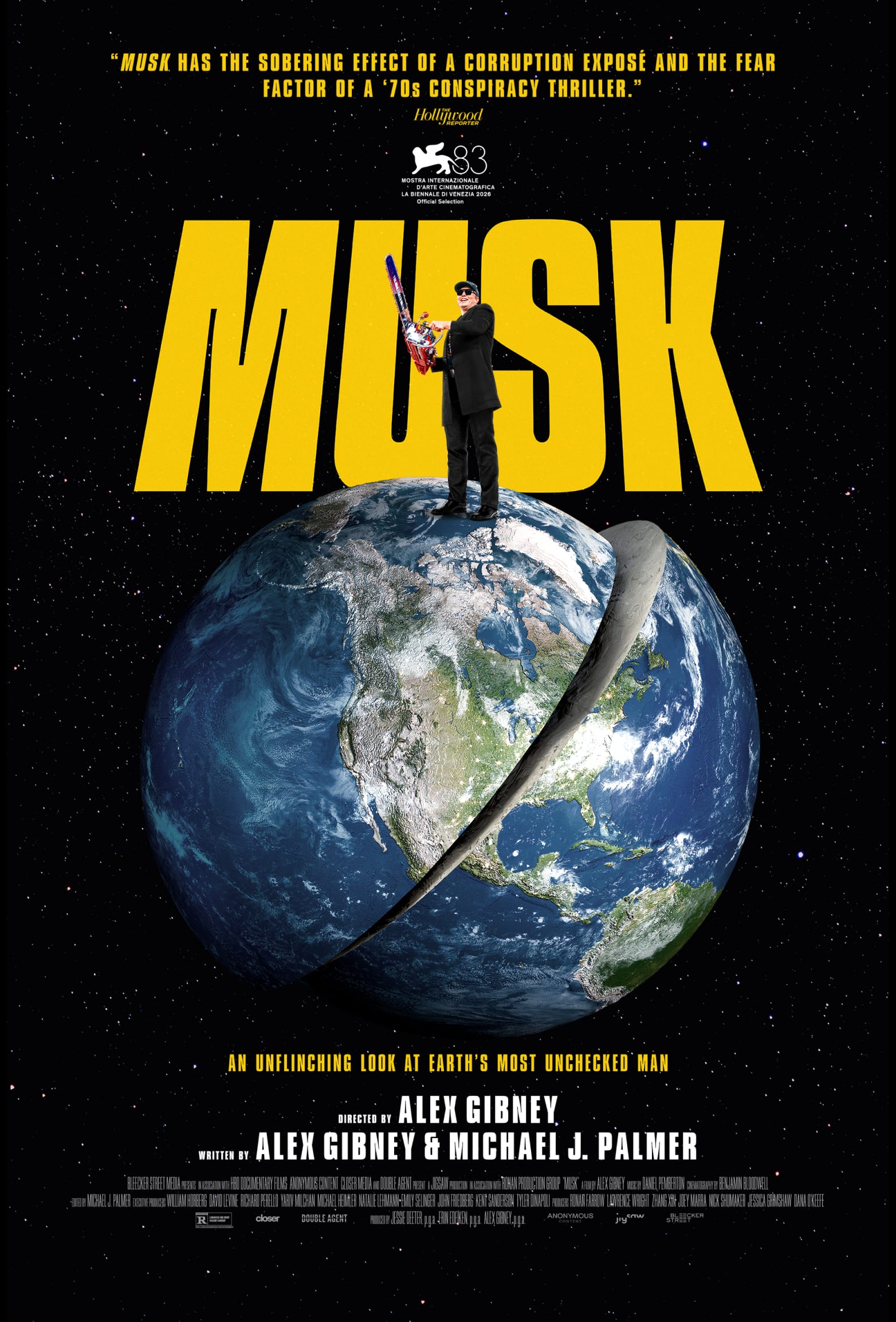
An incisive look behind the legend of Elon Musk, the world’s most heralded “inventor-entrepreneur” who has enormous influence on the world in which we all live.
Movie trailer for the Musk documentary.
“Musk”: Alex Gibney on New Film, Legal Threats & Elon Musk Spending $366M to Help GOP in Midterms on Democracy Now! on October 12, 2026.
Transcript
This is a rush transcript. Copy may not be in its final form.
We speak with the Academy Award-winning director Alex Gibney about his new documentary Musk, an expansive, nearly four-hour examination of the world’s first trillionaire and how he has amassed unprecedented power in business, technology and politics. The film traces Elon Musk’s early ventures and the rise of SpaceX and Tesla, examining the role of government support in their growth. It also explores his acquisition of Twitter, now X; his alliance with President Donald Trump and the MAGA movement; and his role in the Department of Government Efficiency, or DOGE, whose cuts devastated federal programs, including USAID.
Gibney says Musk has carefully crafted an image of a “polymath” who can solve the world’s most pressing problems, but that he is really “kind of a ruthless businessman” willing to do whatever it takes to succeed, including “a series of elaborate cons” to win government support for his companies
AMY GOODMAN: This is Democracy Now!, democracynow.org, The War and Peace Report. I’m Amy Goodman, with Juan González.
The world’s richest man is pouring hundreds of millions of dollars into the November midterm elections in an effort to help Republicans hold on to their Senate majority. Elon Musk, the world’s first trillionaire, has reportedly funneled more than $366 million into Republican groups and his own super PAC, according to The New York Times. That makes him by far the largest known donor to this year’s midterms. Musk and President Trump have appeared together at three events over the past two weeks, praising one another, after a very public falling-out last year. And Musk is doing all this while overseeing a sprawling business empire that’s benefited enormously from federal contracts.
We spend the rest of the hour on a new documentary about Musk and the unprecedented power he’s amassed in business, technology, politics and beyond. The epic, nearly four-hour-long film by Academy Award-winning director Alex Gibney is called simply Musk. Gibney says he set out to answer two fundamental questions: How could Musk amass so much power, and why had we given it to him? This is the film’s trailer.
ELON MUSK: What are the odds that we are in base reality? Like, we are in a simulation.
ANNOUNCER: Give it up for the greatest capitalist in history!
ELON MUSK: Aaahh!
ALEX GIBNEY: Elon Musk is one of the most controversial figures in the world, so I decided to make him the subject of my next film. But it soon became clear Elon would not participate.
UNIDENTIFIED: Between what SpaceX has accomplished and what Elon has been saying they will be doing, there is a big leap.
ELON MUSK: Gonna build a city on Mars.
ADAM BECKER: When Musk says that the future of humanity is to colonize Mars, he is selling us dreams. That’s not happening.
MARTIN EBERHARD: When we started Tesla, he agreed to be the lead investor. What I learned in that process is there’s no legal definition of “founder.” You could call yourself a founder.
ALEX GIBNEY: Really?
MARTIN EBERHARD: Sure.
AWARD PRESENTER: The CEO Performance Award to our founder, Elon Musk.
CORY DOCTOROW: This is a car that lies to you about what it’s doing.
UNIDENTIFIED: As a result, a young woman lost her life, and a young man was forever injured.
UNIDENTIFIED: Twitter is the place where Elon can tell his side of history.
JUSTINE MUSK: Somebody on Elon’s side referred to us as “the breeders.”
UNIDENTIFIED: There’s 14 that are publicly known, but people around Elon believe that there’s many more.
AIDE: This is an order creating a department known as DOGE.
KATIE DRUMMOND: The conflicts of interest are shocking.
KARA SWISHER: The SEC, USAID, the FAA, a lot of these agencies are the ones looking at him.
ASHLEY ST. CLAIR: He had told me, “I can’t be president, but I can help Trump beat Biden.” I say, “I think we’re going to win.” And he said, “I have 10,000 lasers in space. I knew that hours ago.” What are his actual motivations? Do we even know this man at all?
UNIDENTIFIED: We have one person who’s this chaotic and has this much power. It’s completely insane.
AMY GOODMAN: The documentary traces Musk’s early business ventures, the rise of SpaceX and Tesla, the role of government support for his businesses. It also examines Musk’s acquisition of Twitter, which he renamed X; his political alliance with Trump; and his role in the Department of Government Efficiency, or DOGE, which eviscerated lifesaving federal government programs like USAID. Gibney also examines Musk’s ambitions in artificial intelligence, including his company xAI and the reported integration of its Grok chatbot and other AI models into U.S. military networks.
For more, we’re joined by Alex Gibney, Academy Award-winning director, his new documentary called simply Musk. Alex’s previous films include Enron: The Smartest Guys in the Room, Going Clear: Scientology and the Prison of Beliefand the Oscar-winning Taxi to the Dark Side.
Alex Gibney, welcome back to Democracy Now! Thank you for joining us from Maine. Why don’t we start off by talking about the resistance to even getting this film out, as it’s being released in theaters around the country this week? The Musk empire threatened to sue you. You had platforms saying they wouldn’t run the ads. Explain what is at stake right now.
ALEX GIBNEY: Well, even before the movie was premiered at the Venice Film Festival, Elon Musk’s lawyer, Alex Spiro, threatened to sue us over something that they claimed was in the documentary, but it wasn’t.
In terms of the ads, it was really interesting. We produced the trailer, the trailer you just showed, and then we wanted to run ads for that trailer on YouTube, Facebook, Instagram, TikTok and X — of course, X. All of those platforms denied our ads. We appealed. They denied again. We appealed again. They denied again. They said that they were political advertisements, and on that basis, we were refused the ability to place them there. Then, there was an article was written exposing this, and mysteriously, YouTube and Meta said, “Oh gosh, sorry, just a mistake.” TikTok still won’t run the ads, and X claims they are, but so far as I know, they’re not. What it does testify to is this enormous sort of shrinking of political discourse because these massive platforms, which are controlled by tech oligarchs, are limiting speech.
JUAN GONZÁLEZ: And, Alex, what is it that got you to decide to do a film on Musk in the first place?
ALEX GIBNEY: It’s a good question. Some people came to me and asked me to do it. This goes back to 2022, long before he had hitched his wagon to Trump. And I wasn’t sure I wanted to do it initially, but I was convinced by a friend that it was about 21st-century power. And so it was. I just didn’t realize how much his economic power was going to fuse with political power at the time I started.
JUAN GONZÁLEZ: What I found especially fascinating in the film is I, like most Americans, assumed that what most people know — knew originally about Musk was of Tesla, and you tell a different founding story about Tesla than most people are commonly aware of. Could you talk about that and his battle with — was it Martin Eberhard?
ALEX GIBNEY: Sure. I mean, it’s interesting. Most people think that Elon Musk is the founder of Tesla and also the prime inventor of the technology at Tesla, and that just isn’t true. He was an investor, not an inventor. The real inventor was a man named Martin Eberhard. He and his partner Marc Tarpenning founded Tesla. They were the ones who came up with the original technology of the lithium-ion battery pack, which is the thing that gives Tesla so much torque. And they also had the original business plan of starting at the high end of the market and, as people began to adopt the car, driving costs down.
Musk came in, invested in the company, and after a while, they had a falling-out. And Musk engineered Martin Eberhard’s departure. Eberhard sued for money he thought he was owed, and Musk would only agree to settle the lawsuit if Eberhard agreed to say that Musk was what he wasn’t, which was the founder of Tesla —
AMY GOODMAN: I mean, this is unbelievable.
ALEX GIBNEY: — which I find very interesting. I mean, to go to that —
AMY GOODMAN: I wanted to interrupt for one second, because I wanted to go to a clip from your documentary that goes to this, the documentary Muskdescribing the origins of Tesla.
ALEX GIBNEY: When Musk fired Eberhard, Musk refused to pay him what he claimed he was owed. A lawsuit followed, and it was settled only when Musk was able to claim that he was what he wasn’t: a founder of Tesla.
MARTIN EBERHARD: What I learned in that process is there’s no legal definition of “founder.” You could call yourself a founder. There’s nothing illegal about that.
ALEX GIBNEY: Really?
MARTIN EBERHARD: Sure. Why not? You should be. You’d be a good founder. I have with me the incorporation papers for Tesla Motors, and you’ll see his name is nowhere on them.
AMY GOODMAN: So, Alex Gibney, take it from there. It’s really astounding.
ALEX GIBNEY: It is astounding. And what’s astounding is that Musk would go to such lengths to sort of embrace this lie. And I think there are a number of reasons for that. One is he wants people to know — or, he really feels it’s important for people to think that he’s this polymath, this sort of Leonardo da Vinci-like figure, when, in fact, what he is is a kind of a ruthless businessman — with some talents, we should all admit, but not an inventor.
And the other thing that’s interesting, too, is that when it comes to Silicon Valley, being a founder is what entitles you to all sorts of money, and the ability downstream, even when your company’s economic fundamentals don’t justify a big valuation, to pitch people on the idea that, “Don’t worry, we may not be making money now, but in the future, you’re investing in this man, Elon Musk, who’s a genius. He’s an inventor. He’s all these things” — which of course, he isn’t.
AMY GOODMAN: I wanted to go to the amount of government money — that’s taxpayer money — that has gone into all of these businesses, ultimately, all of these companies, recognizing that they get involved with the military — he’s running, what, the future of war for Hegseth at the Pentagon now — that that’s where the biggest bucks are. But go back to the beginning, to how he positioned Tesla, and then going into SpaceX, and recognizing what would get him the money and what wouldn’t.
ALEX GIBNEY: Well, it’s interesting, because, particularly with SpaceX, I mean, Musk has always positioned himself as this kind of free-wheeling entrepreneur who did what he did just by the dint of hard work and independence. But, I mean, SpaceX, for almost all of its existence, has been more or less a socialist enterprise. It had one customer, and that’s the government of the United States. Tesla benefited early on, particularly under the Obama administration, from a number of loans and subsidies for EVs, and also the state of California helped to subsidize Tesla early on. So, Tesla itself as a company would be unimaginable without those subsidies and never would have made it.
The other thing that he’s done, particularly at Tesla, is when he ran out of government subsidies and his ability to get money from venture capitalists, there was only one place left to go, and that was the stock market. So he started making increasingly bold, outlandish and, really, fictional claims about his company in order to get a high valuation, which is what allowed Tesla to, you know, prosper.
JUAN GONZÁLEZ: And could you talk, as well — in the film, you go into the various situations where Musk really almost — practically pulled a scam on government. The rechargeable — the swapping of batteries in Tesla that enabled him to be able to get a hold of all of these EV credits from California, could you talk about that, as well?
ALEX GIBNEY: Sure. I mean, you know, very early on, in order to get this money from the government, he had to engage in a series of elaborate cons. And maybe the first one is the most outlandish and the most interesting. He had this big demonstration where he claimed to solve the essential problem of the EV. And what is that essential problem? It’s range. Everybody worries about range, you know, because unlike a gas car, you can’t pull into a gas station and juice up your battery. Well, Musk held this big demonstration where he said, “Oh yes, you can. We have a thing called a battery swap.” And he holds this big demonstration where something strange underneath the the chassis of the car happens, and he claims to be swapping out a battery, and that for that, because he did it once, he was able to get an extraordinary subsidy from the government of California.
But the thing is, you know, he claimed that he was going to try to do that on a grand scale so that people really could do this. He had one battery swap station. There was a journalist there who observed that it never happened. Nobody ever went in. Well, people tried to go in, but there were no battery swaps because, you have to understand, the battery in a Tesla is a thousand pounds. OK? And it’s usually covered with sealant and stuff like that. But Musk, you know, sort of gulled the government of California into thinking it could be swapped out like double-A batteries. So, it was really an outrageous con.
AMY GOODMAN: What about the self-driving cars, what you describe here in this documentary, the information that Tesla would not reveal the number of people who died? Explain what took place in the settling of these lawsuits so that information would not come out.
ALEX GIBNEY: I think the thing that we have to understand about Tesla’s attempt to, you know, develop self-driving cars was that it was always a stock market play, because, otherwise, you were just an ordinary car company. But for years, he was touting his technology. And his technology was basically a camera technology. The cameras in the cars, you know, take stock of what’s going on around them. It feeds data to the system. AI then, you know, teaches the car how to drive on roads. That’s the theory of it. OK? But he also never put in the redundant systems that Waymo has — radar and lidar, and so forth and so on. So, the problem came between the distance of Musk’s hype and pitch and what the cars could actually do.
There’s a famous ad that they ran in 2016 called the “Paint It Black” ad, from the Rolling Stones song that, you know, accompanies it, where you see a car driving itself and says — and it’s touted as a technology that in fact exists, but, really, at the time, that technology couldn’t tell the difference between a red light and a green light, which is a pretty fundamental issue that you need to sort out for safety in a car.
And as a result, as you say, over 60 people lost their lives as a result of Autopilot failures. And in the case of many lawsuits, they were able to be settled so that the information about all of this wouldn’t come out. There was one very powerful lawsuit brought by a woman who died, who was a pedestrian, who was literally killed by a runaway Autopilot Tesla, and one of the things that was discovered was that Tesla was effectively hiding evidence from them, which they were able to obtain with the help of a Russian hacker, which showed that Tesla knew very well how and why the car malfunctioned, but they weren’t sharing it with the investigators. As a result, there was a rather large judgment against Tesla, the first one.
And I think, you know, going back to the campaign contributions, if I may, I think that this issue of fraud at — or, alleged fraud at Tesla is one of the investigations that he was facing when he hitched his wagon to Trump, and I strongly believe that one of the reasons he’s flooding the political campaigns with so much money now is he wants to avoid investigations in the future.
AMY GOODMAN: This is a critical point. But I want to go back to your documentary, Musk, featuring rare interviews with people previously in Musk’s inner circle, including Ashley St. Clair, the former conservative influencer, mother of one of Musk’s kids. She says she was offered a nondisclosure agreement in exchange for financial support, but she chose not to sign it, saying she felt a moral obligation to speak publicly about her experience. Musk has disputed her account of a $40 million offer with $100,000 a month. This is a clip from Muskfeaturing Ashley St. Clair.
ASHLEY ST. CLAIR: If you were to ask someone on the right what they think of Elon, he’s a free speech god; and someone on the left, he’s just someone who sends hateful tweets, and he’s lost his mind. Both are very comforting, but both are completely insufficient to the immense amount of power and influence he has.
AMY GOODMAN: And this is Ashley Sinclair from the trailer for Musk.
ASHLEY ST. CLAIR: He had told me, “I can’t be president, but I can help Trump beat Biden.” I say, “I think we’re going to win.” And he said, “I have 10,000 lasers in space. I knew that hours ago.” What are his actual motivations? Do we even know this man at all?
AMY GOODMAN: So, let’s go to who spoke to you, Alex, and who wouldn’t speak to you — I mean, Ashley St. Clair would not sign a nondisclosure agreement — and the fear of retribution that others had, and then go to your point that you’re making about — I mean, it goes to DOGE, as well, taking out the very agencies and inspectors that would be investigating him if Democrats win.
ALEX GIBNEY: That’s right. So, I think that — I mean, look, I talked to hundreds of people, or myself and my team talked to hundreds of people, many people off the record, some on background. But it was tremendously hard to get people to come on camera to speak. Over time, we were able to get some key people — Reid Hoffman, you know, who was part of the PayPal Mafia, knew Musk early on; Justine Musk, his first wife; Ashley St. Clair, you showed; as well as a number of people involved in the origin of his companies. So, you know, it took some doing, but I think there was a tremendous amount of fear that Musk would either sue them out of existence or would launch sort of vitriolic attacks on them on X, which has a kind of ramification, because once you start the rage loop on something like X, all sorts of crazy people come out of the woodwork, and the next thing you know, you’re being doxxed or you’re being chased. It can be a very scary thing. But some very courageous people were — you know, did come forward, and it was tremendously helpful in order to give dimension to this character.
But I do want to — you know, a lot of people have gone to sort of the ideological underpinnings of Musk, and I think, to some extent, those are overdone. I think he’s always behaved in a very pragmatic way. I mean, when he needed money from Barack Obama, he was, you know, liberal. But then, when he — you know, in 2024, when he suddenly hitched his wagon to Trump, it seemed like, “This is the guy I believe in. It’s his ideas that are so important.” Well, he was also facing a tremendous number of civil investigations into his companies for abrogating workers’ rights, for pollution, for all sorts of other things, and a criminal investigation into possible fraud at Tesla.
Now, once Trump is elected, Musk is put in charge of the Department of Government Efficiency, which really had nothing to do with waste, fraud and abuse. Its two goals, as far as I’m concerned, were, one, to destroy the regulatory state — and he starts first with the agencies that are regulating him — and then, the next thing, I think, that, you know, was a kind of key goal for DOGE, for Musk, was the access of federal data, not only classified information, but also access on all of us, from our Social Security data, our Medicare data, so forth and so on.
You know, the DOGE boys, which we all — whom we all remember as these callow kids from some of Musk’s companies going into federal agencies and literally knowing nothing about them and cutting jobs here, cutting jobs there, a little bit like, you know, firing the pilot while he’s flying the plane, without any regard to how damaging or dangerous that might be. So, you could say that they were reckless and “What were they doing?” and it was crazy, but, actually, there was an ulterior motive here. All these kids were very savvy about how to access IT and data at these federal agencies. They had what’s called super admin status, which meant that they could see data across the silos that are normally put in place either to protect our privacy or to protect classified information. And I’m told by heads of IT at those agencies that moving that data to SpaceX, for example, would have been as easy as a drag and drop — you know, taking a computer file and putting it into a folder. So, that’s a really terrifying idea. Now, we don’t — I can’t prove that that’s what he did, but I strongly suspect it is.
AMY GOODMAN: Alex Gibney, we want to congratulate you on your film, Academy Award-winning director. His new documentary is Musk. We hope to do Part 2 and post it online.
Happy birthday to Miguel Nogueira! And an early happy birthday to Juan González!
By the way, Steal This Story, Please!, the documentary about Democracy Now!, will be viewable online for the first time in an exclusive special event starting tonight at 8 p.m. Eastern. If you live in the U.S. and Canada, you can watch the film in your own home and be part of the post-screening question-and-answer with me and the filmmakers Tia Lessin and Carl Deal, moderated by the Pulitzer Prize-winning journalist Maria Hinojosa. Find out more at StealThisStory.org. Join us and help support the impact of this film that celebrates the importance of independent media. I’m Amy Goodman, with Juan González, for Democracy Now!
The above transcript and video clip are referenced here under a Creative Commons License. The original material is at: “Musk”: Alex Gibney on New Film, Legal Threats & Elon Musk Spending $366M to Help GOP in Midterm