


Date added to Middle East Centre Booktalk series: 27/02/2026
This book talk was delivered at the Middle East Centre on Tuesday 10 February 2026 by author, Dr Daniel Neep (Brandeis University), and chaired by Professor Eugene Rogan (St Antony’s College).
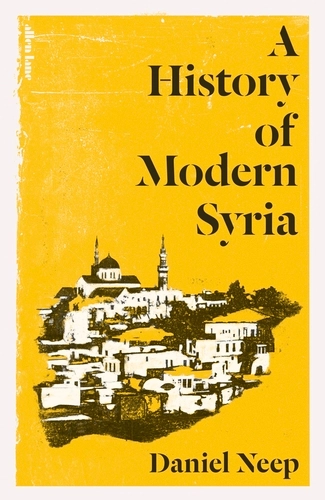
A Modern History of Syria (2026) https://www.penguin.co.uk/books/213366/a-history-of-modern-syria-by-neep-daniel/9780241003299
Few countries have had as vexed a political history as Syria. Carved out of the Ottoman empire at the end of the First World War, Syria was then brutally ruled by France. This French ‘mandate’ carved out new borders with equally provisional neighbours in a process that pulled apart families, trade networks and political assumptions that had already been ravaged by the war.
Syria’s subsequent history has been a series of attempts to make sense of its borders, including a failed attempt in the late 1950s to unite with Egypt and several humiliations at the hands of Israel’s armed forces. The civil war that broke out in 2011 plunged Syria into a nightmarish series of disasters, including the terrible years of Islamic State, ultimately resulting in the reimposition of Bashar al-Assad’s dictatorship, which came to an end in 2024.
Daniel Neep’s remarkable book creates a gripping, intelligent narrative of how Syrians have lived through these events, never losing sight either of the fates of ordinary people or of Syria’s rich, complex and diverse society, unwillingly or willingly brought together in such a highly contested space.
Transcript:

00:00:00 Speaker 1
Good evening, dear audience.
00:00:02 Speaker 1
We are here to celebrate the publication of something that's always laid at the heart of
this Middle East center, which is to say the history of Syria.
00:00:12 Speaker 1
Since Albert Hirami's time, I think Syria and Lebanon have played a kind of pole position
in the interests of the research carried out by Albert himself, inspired as he was by one
of his mentor figures, Philip Hicti.
00:00:29 Speaker 1
and transmitted to generations of scholars who have come through the doors of the
Middle East Centre, people like Philip Houry, the list is long.
00:00:41 Speaker 1
And so seeing a new work of synthesis of such proportions addressing the history of
Syria feels like precisely the kind of book that we should be bringing to the Middle East
Centre to discuss.
00:00:54 Speaker 1
And the author is, of course, no stranger to Oxford, to its Middle East Centre.
00:00:59 Speaker 1
Daniel Niep is a historian of the modern Middle East whose focus is on Syria and the
eastern Mediterranean and the long-term history of state formation.
00:01:08 Speaker 1
He studies political economy and social conflict.
00:01:11 Speaker 1
He's held academic and research positions at the University of Exeter, at the Council
for British Research in the Levant, at Georgetown, George Washington, and is currently
a non-resident research fellow at the Crown Center for Middle East Studies at Brandeis.
00:01:28 Speaker 1
Now, on top of having studied Arabic and French here at Oxford in the 1990s, Daniel's
lived in Syria since that time, and subsequently spent many years based in Damascus.
00:01:39 Speaker 1
And it's those experiences that really shaped his engagement with the history of Syria,
and studying the Arabic language, and studying the country through its institutions and
sources.
00:01:50 Speaker 1
His first book, Occupying Syria under the French Mandate, was published by
Cambridge University Press.
00:01:55 Speaker 1
And his new book is A History of Modern Syria, which has just come out this year with
Alan Lane and will come out shortly in New York with Basic Books.
00:02:04 Speaker 1
So Daniel has agreed to give us an introduction to his book.
00:02:08 Speaker 1
I'll start the conversation at the front of the room.
00:02:10 Speaker 1
We'll open the floor to your questions.
00:02:13 Speaker 1
So settle back.
00:02:14 Speaker 1
We're in for a great evening talking the history of Syria.
00:02:17 Speaker 1
Please welcome Daniel Ean.
00:02:21 Speaker 1
Welcome back.
00:02:33 Speaker 2
Thank you, Eugene.
00:02:34 Speaker 2
I would like to thank the Middle East Centre for hosting this event, and Eugene, of
course, for chairing it first.
00:02:39 Speaker 2
It really is a privilege to have the opportunity to discuss the history of Syria here with you
today, and thank you all for coming.
00:02:46 Speaker 2
This book has had a long gestation.
00:02:50 Speaker 2
It began in Damascus in 2011, where I was living and working during the early
00:02:55 Speaker 2
months of the uprising, at a moment when political outcomes felt radically uncertain
and the ways we were accustomed to explaining Syria no longer seemed to work in
quite the same way.
00:03:07 Speaker 2
December 2024 marked another such moment.
00:03:10 Speaker 2
The collapse of the Assad regime once again unsettled assumptions that had gradually
come to feel fixed.
00:03:16 Speaker 2
And I think it's the distance between these two moments that really has shaped how
this book was written and the kind of history it tries to tell.
00:03:24 Speaker 2
Yet, in another sense, of course, the origins of this book go back even further than that,
back to my undergraduate years here in Oxford, when I was first, I began studying
Arabic and trying in a much more tentative way to make sense of Syria as a lived social
and historical space.
00:03:41 Speaker 2
And of course, back then, my early engagement was not shaped by a clear research
agenda.
00:03:46 Speaker 2
It was more shaped by immersion, you know, language study, extended periods in the
region.
00:03:51 Speaker 2
and a growing awareness that the categories through which Syria was usually
explained, authoritarianism, sectarianism, regional instability, rarely captured how
Syrians understood their own past or navigated that present.
00:04:06 Speaker 2
So I think it's these long years of engagement with the country which pushed me
towards a history that takes Syria seriously on its own terms, as a society with a long
and contested record of political experimentation, social hierarchy,
00:04:21 Speaker 2
and institutional improvisation.
00:04:23 Speaker 2
So the book that's emerged is therefore not a response to a single moment of crisis, but
of sustained engagements across various periods, of the Hafs al-Assad and the Bashar
al-Assad, the uprising, wartime and now post-regime collapse.
00:04:37 Speaker 2
And each of those moments has really forced a reconsideration of what kinds of
historical questions are worth asking and which kinds of explanation attraction.
00:04:47 Speaker 2
Let me start where the book ends.
00:04:50 Speaker 2
In December 2024, when of course the regime of the Assads, which had brutally
dominated Syria for over 50 years, suddenly collapsed during the lightning advance by
rebel forces, this turn of events was unexpected.
00:05:04 Speaker 2
The regime had survived 13 years of vicious and chaotic conflict at the terrible cost of
over half a million dead, 14 million refugees and displaced people, and the devastation
of entire neighbourhoods, towns and villages.
00:05:18 Speaker 2
But a system
00:05:19 Speaker 2
which had appeared so durable, could unravel so quickly, came as a shock to many
who had come to treat the survival of the regime as a fact of political life in Syria.
00:05:29 Speaker 2
Today, Syrians face the monumental task of rebuilding their country, not only physically
and economically, but also politically.
00:05:36 Speaker 2
For the first time in over half a century, fundamental questions that have been long
closed off are once again open to debate.
00:05:43 Speaker 2
What kind of constitution should Syria adopt after Assad, and who should write it?
00:05:48 Speaker 2
Should power remain concentrated in the central state as in the past, or be devolved to
the regions?
00:05:54 Speaker 2
Should the economy be open to international competition, or tightly controlled by the
governments on behalf of the population?
00:06:01 Speaker 2
Even the fact that such questions can now be asked openly is itself remarkable.
00:06:06 Speaker 2
Only a few years ago, many outside observers doubted Syria's continued viability as a
sovereign state.
00:06:13 Speaker 2
Yet by 2026, the breaking of Syria appears less likely than its remaking.
00:06:20 Speaker 2
Now, for the historian, I think, this moment is perhaps less striking for its novelty than
for the way it recalls earlier periods in which Syria's political future appeared suddenly
open, uncertain and contested.
00:06:33 Speaker 2
The prospect of remaking Syria might appear novel,
00:06:37 Speaker 2
But it's not without historical precedent.
00:06:39 Speaker 2
And in many respects, debates over the future of Syria in the mid-2020s mirror many of
the same political preoccupations with which successive generations of Syrians have
been grappling for over 200 years.
00:06:52 Speaker 2
Recurring debates over sovereignty, reform, inequality and political authority, even as
the conditions under which those questions were posed changed dramatically.
00:07:04 Speaker 2
So A long-term historical and sociological perspective, such as the one I adopted in the
book, shows how the country has been shaped by fitful bursts of repression and
protest, tyranny and rebellion, as different would-be rulers have sought to impose their
political vision on Syria.
00:07:19 Speaker 2
Of course, the difficulty of imposing that vision has been compounded, not only by the
country's ethnic, religious and sectarian diversity, but also by the sheer speed of
political change and social transformation during this time.
00:07:33 Speaker 2
From the Ottoman Empire to French colonialism to post-independence experiments
with liberalism, socialism and military dictatorship, Syrians have struggled to steer the
direction of the country while navigating sea changes in the global economy,
tempestuous geopolitical rivalries and frantic competition between domestic political
forces scrambling for control over resources, status and power.
00:07:58 Speaker 2
The sedimented legacies of these struggles
00:08:02 Speaker 2
mean that Syria has been remade many times before, but never entirely under
conditions of its own choosing.
00:08:10 Speaker 2
So what my book represents is an attempt to recover those longer processes as
historical inheritances, not as background to the present, but as a way of thinking more
carefully about political order in Syria, how it's been built, how it's endured, and why it
has so often proved vulnerable to strain.
00:08:30 Speaker 2
Now, to avoid telling 2 centuries
00:08:32 Speaker 2
as a mere chronology of regimes and coups, I've organized the narrative around the
problem of uneven development.
00:08:40 Speaker 2
Now, uneven development sounds like a technical phrase, but the understanding
behind it is fairly ordinary.
00:08:46 Speaker 2
It refers to the way in which economic change, state investment, infrastructure, and
even coercive power don't spread evenly across space or society.
00:08:56 Speaker 2
Some regions are pulled into markets early, others are treated as backwaters until
suddenly they become valuable.
00:09:01 Speaker 2
Some groups in those regions acquire property, education, and political access.
00:09:07 Speaker 2
Others are included, mainly as labour, taxpayers, or conscripts.
00:09:12 Speaker 2
So the result is not simply inequality in the abstract, but a very specific geography of
inequality, a country which is experienced very differently, depending on whether one
lives in a commercial quarter of Damascus,
00:09:26 Speaker 2
a green village in the Haram, a drought-prone area at the Jezira, or the edge of Aleppo's
industrial dams.
00:09:32 Speaker 2
So this perspective also shapes how familiar explanations of Syria's history are treated
in the book, not as claims to be refuted 1 by 1, but as products of, I think, often short
historical vision.
00:09:45 Speaker 2
And in each of the familiar explanations that we've all heard about Syria for so long
contains an element of truth, but each one also
00:09:54 Speaker 2
distorts the historical record in ways that obscure more than they illuminate.
00:09:59 Speaker 2
So let me briefly outline 3 examples.
00:10:02 Speaker 2
The first comes in the persistent invocation of the Sykes-Pico agreement as their basic,
the foundational explanation of Syria's instability.
00:10:09 Speaker 2
The argument here, of course, is that Syria's borders were imposed arbitrarily by
colonial powers, grouping together disparate communities and producing a state that
was never viable.
00:10:19 Speaker 2
This narrative has proven remarkably durable.
00:10:22 Speaker 2
in part because I think it offers a clean origin story for disorder.
00:10:26 Speaker 2
Yet the idea of Syria as a political and cultural space predates the First World War.
00:10:32 Speaker 2
The processes of administrative integration, infrastructure development, and even
regional consciousness were already well underway in the 19th century.
00:10:42 Speaker 2
So the importance of external borders is it's not really that they bisect arbitrarily group
identities,
00:10:49 Speaker 2
but that they reorganize administrative centrality and access, which cities become
hubs, which regions become margins, who gets infrastructure and contracts, and who
meets the capital chiefly through coercion.
00:11:02 Speaker 2
Sectarianism offers a second example.
00:11:05 Speaker 2
In a lot of contemporary commentary, sectarian difference is presented as a kind of
latent force that, once released, overwhelms all other forms of political identification.
00:11:16 Speaker 2
So the civil war is then read as the inevitable outcome of long-suppressed communal
divisions.
00:11:22 Speaker 2
And this view, again, it depends on the short historical frame that treats sectarian
identities as fixed and primordial.
00:11:29 Speaker 2
A longer-term perspective reveals something quite different.
00:11:32 Speaker 2
Sectarianism in Syria has taken multiple forms over time, as episodic communal
violence, as a strategy of political mobilization, and even as the byproduct of
institutional bias and uneven development.
00:11:46 Speaker 2
at various points in serious modern history.
00:11:48 Speaker 2
Sectarian affiliation has mattered less than region, class or ideology.
00:11:53 Speaker 2
So if we read the war of the 2010s primarily through a sectarian lens, it's kind of
projecting the outcome backwards and allowing the end of the story to determine its
beginning.
00:12:04 Speaker 2
And finally, short time horizons even affect how economic reform is understood.
00:12:09 Speaker 2
So the liberalization measures introduced in the late 20th and early 21st centuries
00:12:14 Speaker 2
are often portrayed either as cynical window dressing or as the decisive rupture that
destroyed a previously stable authoritarian social contract.
00:12:23 Speaker 2
And both these interpretations simplify a much longer story.
00:12:27 Speaker 2
If you frame reform purely as neoliberal betrayal, its cumulative effects and its
interaction with older institutional arrangements are missed.
00:12:36 Speaker 2
So taken together, these narratives will show the cost of short time horizons.
00:12:41 Speaker 2
they offer clarity, but at the expense of depth.
00:12:43 Speaker 2
They offer a certain coherence, but at the expensive understanding of the process.
00:12:47 Speaker 2
And they encourage us to see, to explain Syria by locating just one moment, a single
moment of failure, colonial partition, sectarian eruption, or economic liberalization,
rather than by tracing how political order was repeatedly assembled, strained, and
reassembled over time.
00:13:07 Speaker 2
The result, I think, is not just to get the history wrong.
00:13:10 Speaker 2
It's not just an analytical error.
00:13:12 Speaker 2
It's a certain narrowing of imagination, one in which Syria's past just looks like a series
of mistakes, and its future then becomes a problem of repair and reconstruction, not as
another phase of historical remaking.
00:13:26 Speaker 2
So this is why I use uneven development as the main framing of the book, because it
allows me to explain political rupture without reaching for cultural fatalism.
00:13:36 Speaker 2
And more modestly, I think it offers a way of writing about modern Syrian history that
keeps catastrophe in view without allowing it to determine the narrative.
00:13:46 Speaker 2
As I note at the beginning of the book, it is the liberalization of the 2000s, which
dramatically reshaped the country's urban geography and exacerbated long-standing
inequalities between serious diverse regions.
00:13:58 Speaker 2
and the protests of 2011 at first were initially more about changing this deeply uneven
system than they were about overthrowing the regime.
00:14:06 Speaker 2
So the story here is about how stratified social and regional development repeatedly
generates political conflict.
00:14:15 Speaker 2
So the emphasis throughout the book is on this kind of inheritances, not on inevitability.
00:14:22 Speaker 2
So to see where this matters, it helps to start where the book starts, which is the 19th
century countryside.
00:14:27 Speaker 2
Before modern property rights and cadastral registration, much rural land in Ottoman
Syria was cultivated through Mashar, a communal system in which strips of land were
periodically redistributed among families.
00:14:40 Speaker 2
Now the logic was not egalitarianism in any abstract sense, but risk management.
00:14:44 Speaker 2
In an environment where rainfall is unreliable and harvest failure common, the system
spread exposure.
00:14:51 Speaker 2
between households.
00:14:52 Speaker 2
When Ottoman reformers introduced compulsory land registration through the 1858
land code, they hoped to rationalize taxation and incentivize investments.
00:15:01 Speaker 2
But this reform produced the opposite effect.
00:15:04 Speaker 2
It accelerated the concentration of land in the hands of notable families, creating
absentee landlords in cities who extracted profit from presents turned into tenant
sharecroppers.
00:15:14 Speaker 2
This is basically Syria's equivalent of the enclosure of the commons.
00:15:18 Speaker 2
And the book doesn't treat this process as an incidental agrarian question.
00:15:22 Speaker 2
It is the making of a social hierarchy that later politics both reproduces and contests.
00:15:28 Speaker 2
And this mechanism matters because it's spatial.
00:15:31 Speaker 2
Land registration unfolds unevenly across regions.
00:15:35 Speaker 2
And the book explicitly proposes analyzing variation across multiple zones, interior
cities, not Lebanon, the Haran, the coastal mountains, and the eastern lands, including
the Jazeera and the desert.
00:15:47 Speaker 2
So in the interior, for example, suspicious peasants often did not register notables did,
sometimes claiming they were protecting villagers from the state, sometimes buying up
forfeited land.
00:15:57 Speaker 2
And the result is effectively legal robbery, with peasants left to survive and punishing
shares of the harvest, sometimes just 1/4, under conditions of erratic rainfall.
00:16:07 Speaker 2
So uneven development here is not a consequence of later neoliberalism.
00:16:11 Speaker 2
It's baked into the legal and fiscal infrastructure of the modern state.
00:16:17 Speaker 2
And once you have that in view, you can interpret 20th century politics in Syria as
repeated attempts to manage, exploit, or redress these unevennesses, plural, usually
with mixed motives and almost always with unintended consequences.
00:16:34 Speaker 2
Take the post-independence liberal period in the late 1940s, when the Syrian upper
middle class inherited government after the departure of the French.
00:16:43 Speaker 2
Syrian liberals asserted that privacy
00:16:45 Speaker 2
of an urban power centre over a rural periphery that was poor and often treated as
politically suspect.
00:16:53 Speaker 2
Their economic policy favoured nascent light industry, frequently owned by the
politicians themselves, of course.
00:17:00 Speaker 2
And questions of social reform were nowhere on the agenda.
00:17:03 Speaker 2
So this is uneven development as a political project.
00:17:07 Speaker 2
Protect the city's commercial and industrial strata, treat the countryside as a reservoir
of extraction,
00:17:14 Speaker 2
and then act surprise when peripheral unrest becomes crime.
00:17:18 Speaker 2
In the late 1940s, Damascus liberals addressed this unrest by manipulating internal
Druze rivalries and using coercion to repress Alawi rebellions, methods that later
observers might mislabel sectarian management, but which are, in my telling,
techniques for controlling A marginalized periphery.
00:17:38 Speaker 2
Then we have the Baath Party, of course, which presents itself fairly credibly at first as a
corrective land reforms and nationalisations after 1963 break the back of the old
bourgeoisie.
00:17:50 Speaker 2
Yet the book isn't a simple celebration of state-led equalisation.
00:17:55 Speaker 2
It tracks the oscillation.
00:17:57 Speaker 2
Hafs al-Assa's more moderate economic stance.
00:17:59 Speaker 2
We always describe Hafs al-Assa as more moderate.
00:18:02 Speaker 2
That's amazing.
00:18:04 Speaker 2
Hafs al-Assa's more moderate economic stance in the 1970s.
00:18:07 Speaker 2
grants the older leader reprieve while consolidating state power and nurturing a new
class enriched through controlled private sector opportunities.
00:18:16 Speaker 2
So the point here, in my telling, is not that Syrian moved from inequality to inequality
and back again.
00:18:22 Speaker 2
It's the impression you get from reading some more political economy accounts.
00:18:27 Speaker 2
The point is that the forms of inequality change.
00:18:30 Speaker 2
from lands of notable domination to status redistribution with new hierarchies, to crony
capitalism entangled with liberalization.
00:18:38 Speaker 2
I think this is where an even development provides a powerful way to narrate the years
of Bashar al-Assad, certainly the first decade, without turning them into an ideological
caricature.
00:18:49 Speaker 2
I frame Bashar's era as Syria's attempt to articulate a local version of global economic
liberalism.
00:18:57 Speaker 2
The social market economy, in principle,
00:18:59 Speaker 2
promised prosperity without sacrificing gains for peasants and workers.
00:19:04 Speaker 2
In practice, it produced collusion between the new generation of the regime and the
super rich, plus a speculative boom in construction and services that dramatically
reshaped the country's urban geography.
00:19:15 Speaker 2
Now, if you want just one phrase that kind of captures this idea of uneven development
as a lift
00:19:21 Speaker 2
experience urban geography is doing a lot of work here.
00:19:24 Speaker 2
think about the beginnings of gated developments, gentrified waters, a service
economy for the well-connected, and informal peripheries and slums for everyone else.
00:19:32 Speaker 2
And the book talks, you know, it tells the story of how these unevennesses become
politically combustible.
00:19:39 Speaker 2
The drought of 2006 and after pushed at least 300,000 people, you know, whole
families, out of the east into tented settlements on the margins of Damascus, Aleppo,
and down.
00:19:51 Speaker 2
The climate shock was, of course, real, but the book emphasizes that it was amplified
by state policy.
00:19:57 Speaker 2
Deregulated irrigation encourages boomed wells and relentless groundwater depletion.
00:20:03 Speaker 2
Drying tributaries are making water more scarce and more expensive.
00:20:07 Speaker 2
Rental deregulation allowed landlords to expel tenants, producing rural evictions as
land was sold to capitalize on rising real estate values.
00:20:17 Speaker 2
Again, it's the spatial signature of liberalization.
00:20:20 Speaker 2
Fuel subsidy removal hit the northeast hard, and then unemployment and price
increases and followed basic foodstuffs rising 56% between 2000 and 2008.
00:20:29 Speaker 2
So here we have uneven development becoming a political trigger.
00:20:34 Speaker 2
We have people displaced by drought and policy.
00:20:38 Speaker 2
We have peripheral cities absorbing that.
00:20:40 Speaker 2
We have work opportunities shrinking.
00:20:42 Speaker 2
We have prices rising, and we have the state present mainly as police and bureaucracy.
00:20:48 Speaker 2
So when I said earlier that the protests were first about changing a deeply uneven
system, it wasn't just a rhetorical flourish.
00:20:54 Speaker 2
You know, in this context, it's actually a claim about causation.
00:20:58 Speaker 2
It's a claim about what was going on.
00:21:01 Speaker 2
So uneven development in the book is not a detachable theoretical framework.
00:21:06 Speaker 2
You know, it's baked into the book.
00:21:07 Speaker 2
It's the book's method for making Syrian history legible across 2 centuries.
00:21:12 Speaker 2
You know, it allows me to connect
00:21:14 Speaker 2
Ottoman landlord to post-war coups, rural peripheries to urban centres, socialist
redistribution to neoliberal cronyism, drought ecology to political revolt.
00:21:24 Speaker 2
I think it disciplines the narrative too.
00:21:26 Speaker 2
Instead of treating every conflict as a clash of essences or even just a sui generis clash,
it asks the harder questions of who is gaining, who is losing out, which regions are being
privileged, which were sacrificed, and how the state enforced those choices.
00:21:44 Speaker 2
If one theme has dominated the national experience of state building in Syria, I suggest
it is that of the production, reproduction and mitigation of social inequality.
00:21:57 Speaker 2
And I use that phrasing deliberately because I think about state building as a social
relationship, not just a story about institutions.
00:22:07 Speaker 2
And this framing helps explain, I think, why solutions, or putative solutions,
00:22:13 Speaker 2
that put identity politics before economic inequality, it leads to a special suspicion,
particularly amongst many Syrians.
00:22:20 Speaker 2
After all, in Syrian history, this kind of identity talk has often been the language used to
rationalize an unequal order or to manage the anger it producers rather than to describe
the underlying distributional problem.
00:22:36 Speaker 2
So a useful way to learn, I think, is this habit of sectarian thinking.
00:22:40 Speaker 2
that we often have about Syria, something the media often has, is to begin with a
relationship that looks at first landslide and should be sectarian.
00:22:51 Speaker 2
Take, for example, the area in southern Syria, which we can call the Druze Mountain.
00:22:56 Speaker 2
Okay, it's the area of the governor of Sweda, known in the early 19th century as Jebel
Haran, known in the late 19th century as Jebel Druze,
00:23:04 Speaker 2
known from the 1950s onwards as Jalalah.
00:23:07 Speaker 2
So set the Druze Mountain, in inverted commas, against Damascus, the capital of the
Sunni establishment and political life.
00:23:15 Speaker 2
And if you approach that pairing with the usual premises, you soon reach for a story
about minorities and centres, about a heterodox community living in defensive
isolation, periodically clashing with a state which happens to be Sunni.
00:23:32 Speaker 2
And the problem is,
00:23:34 Speaker 2
that the historical record in the book points you somewhere else.
00:23:37 Speaker 2
And the example of the Jews' Mountain and Damascus is indeed important in its own
right, but also does some real conceptual work by illustrating how uneven development
works.
00:23:47 Speaker 2
Beginning with the 19th century.
00:23:49 Speaker 2
I always like to begin with the 19th century.
00:23:52 Speaker 2
Even in the 19th century, the Jabal was not an isolated enclave.
00:23:56 Speaker 2
It was drawn into regional and global circuits through connections of grain.
00:24:01 Speaker 2
as the Midan quarter of Damascus became a crucial hinge between southern Syrian
agriculture and international markets.
00:24:08 Speaker 2
Midani grain merchants procured high-quality wheat grown in the south for export, and
in doing so, they developed durable commercial ties with Jewish fakes, who controlled
agricultural production in the Haran.
00:24:21 Speaker 2
And those ties were not fleeting.
00:24:23 Speaker 2
The merchants kept second homes in Drew's villages, hosted Drew's notables in
Damascus, and even lodged the sons of those sheikhs when they came to study in
Ottoman schools.
00:24:32 Speaker 2
So this is the opposite of a picture in which different religious communities are merely
coexisting at arm's length.
00:24:40 Speaker 2
You know, it's a different type of picture from this notion of a mosaic society, which is
richly tessellated, but every group is separate from it, every piece is separate from the
one next to it.
00:24:51 Speaker 2
This is a story about elite interpenetration, commercial, social, and generational, but
also interreligious and transregional.
00:25:00 Speaker 2
If you're determined to read politics and identity, you can always force this into a
sectarian frame.
00:25:04 Speaker 2
And I think it's a worse explanation than the obvious one, which is mutual benefits
generated by export agriculture and the social infrastructure that comes with it.
00:25:14 Speaker 2
Now, consider this notion of autonomy.
00:25:17 Speaker 2
The Javan's internal social structure was coherent and strongly self-governing.
00:25:21 Speaker 2
It was a layered hierarchy of shaky families and commoners, plus a parallel structure of
spiritual shakes,
00:25:28 Speaker 2
all embedded in village life.
00:25:30 Speaker 2
And this coherence, of course, helped villagers pull together to defend their collective
autonomy against incursions by government authorities at various points in the 19th
century.
00:25:39 Speaker 2
So autonomy here is not a theological reflex.
00:25:42 Speaker 2
It's a political stance made possible by geography, it's mountainous terrain, social
organization, these tight-knit villagers, and the material ability to resist state extraction.
00:25:53 Speaker 2
The chapel's own internal tensions reinforce this point.
00:25:56 Speaker 2
And the book traces how demographic change in the 19th century intensified inequality
within Jewish society.
00:26:05 Speaker 2
And it produced sharecropping and resentment and prompted lesser families to
challenge the status quo.
00:26:11 Speaker 2
And that asymmetry sharpened internal fractures and the chapel itself.
00:26:16 Speaker 2
In the late 1880s, there was a revolt known as the Amir Revolt, which is sometimes
forgotten or sometimes misremembered as a communal unrest.
00:26:25 Speaker 2
But it was an uprising of commoners against the domination of the sheikhs.
00:26:32 Speaker 2
Its targets were land control, labour extraction and social hierarchy within the
mountain.
00:26:37 Speaker 2
So in other words, the revolt was generated by uneven development inside this region.
00:26:42 Speaker 2
It was a product of commercialisation and demographic pressure.
00:26:46 Speaker 2
It wasn't a clash with Damascus as a Sunni centre.
00:26:49 Speaker 2
Identity talk didn't organise this revolt.
00:26:51 Speaker 2
Political economy did.
00:26:54 Speaker 2
So all this is not sectarian politics, clearly.
00:26:56 Speaker 2
It's class and power within a community shaped by grain demand, taxation, and the
changing balance between notables and peasants.
00:27:04 Speaker 2
And if you miss that, you end up imputing to the Druze, in adverted commas, a
collective political will that simply didn't exist.
00:27:15 Speaker 2
And to colonial rule, this unevenness was intensified.
00:27:19 Speaker 2
Under the French mandate,
00:27:21 Speaker 2
The fragmentation of Syria into statelets and special regimes reoriented the country
again and evenly across its regions.
00:27:28 Speaker 2
The Great Syrian Revolt, 1925 to 1927, began in the general because the effects of
administrative intrusion were acutely felt there.
00:27:37 Speaker 2
But it spread because similar grievances existed elsewhere, taxation, force
compliance, exclusion from sovereignty.
00:27:44 Speaker 2
It was the same networks forged through Ottoman schooling, the grain trade, and
administration that connected Druze leaders to Damascene nationalists and allowed
the revolt to travel.
00:27:55 Speaker 2
The French insistence on reading the uprising as sectarian served a political purpose.
00:28:00 Speaker 2
It justified repression.
00:28:02 Speaker 2
It justified divide and rule in the landscape of uneven development that colonial policy
developed to deepen.
00:28:08 Speaker 2
Same logic shows up later on in the 1950s.
00:28:11 Speaker 2
in the Shishaki dictatorship, when the regime's attempt at enforced standardization and
brutal repression of the jabal, even then didn't activate sect as the operative category.
00:28:23 Speaker 2
Shishaki's repression did not provoke an explicitly sectarian reaction.
00:28:27 Speaker 2
The category of sect hadn't yet required political salience.
00:28:31 Speaker 2
Sectarian identity became politicized only later.
00:28:34 Speaker 2
as a byproduct of the ever more restrictive space available for political activism in the
late 1950s and 1960s.
00:28:43 Speaker 2
So what all this shows is that what often looks like identity politics is often the after
image of struggles over state breach, land, trade, and coercion.
00:28:51 Speaker 2
So identity sits in the story, but it doesn't drive it in the way that the sectarian template
assumes.
00:28:57 Speaker 2
And in fact, the sequence is often the reverse of what outsiders sometimes imagine.
00:29:02 Speaker 2
Communal identity becomes politically useful
00:29:04 Speaker 2
only under particular conditions, conspiracy, clandestine trust building, zero-sum
power struggles, crazy anarchy, extreme violence.
00:29:14 Speaker 2
It doesn't operate as politics' timeless foundation.
00:29:17 Speaker 2
And once you see that, a lot of contemporary sectarian explanation starts to look like a
habit of mind, it's not really an analysis.
00:29:25 Speaker 2
The Druze-Damascus relationship, in my telling, is not a morality tale about ancient
enmity between different religious groups.
00:29:31 Speaker 2
It's not even a story about fragile coexistence.
00:29:36 Speaker 2
It's actually a case study.
00:29:37 Speaker 2
It's a case study in how economics can stitch regions together, how state demands can
harden local autonomy, and how identity often arrives late in the story.
00:29:48 Speaker 2
It's kind of an interpretive gloss that obscures the older, sometimes grubbier, and
certainly more instructive realities of politics and material life.
00:29:58 Speaker 2
So
00:29:59 Speaker 2
What a longer historical view in the book makes visible is a sense of precedent.
00:30:05 Speaker 2
And I hope not in the banal sense that Syria has seen this before, but in the more useful
sense that Syrians are today, not rebuilding from scratch.
00:30:13 Speaker 2
There is a long national experience in Syria of state building, constitutional arguments,
social conflict, and attempts, often clumsy, sometimes brutal, to integrate a diverse
society into a single political system.
00:30:26 Speaker 2
And that experience furnishes two kinds of resources.
00:30:30 Speaker 2
One is practical.
00:30:31 Speaker 2
There are plenty of examples of how administrative centralization has been attempted,
resisted, and periodically renegotiated, and how solutions imported from outside have
tended to land badly once they collide with local distributions of wealth, coercion, and
opportunity.
00:30:50 Speaker 2
The other set of resources is symbolic.
00:30:52 Speaker 2
Here there is a usable repertoire
00:30:55 Speaker 2
through which new institutions in Syria can be legitimated as homegrown, not as the
latest external sponsored formula.
00:31:03 Speaker 2
What a book like this cannot offer is a forecast, of course.
00:31:06 Speaker 2
I'm starting to have this question a little bit, so I feel I need to preempt it.
00:31:10 Speaker 2
You know, the book doesn't offer a forecast about what is next for Syria.
00:31:14 Speaker 2
I think Syria at the moment is in a rare interval of genuine uncertainty.
00:31:18 Speaker 2
Prior trajectories do not tell you which coalition
00:31:22 Speaker 2
will harden into a new governing block.
00:31:25 Speaker 2
It doesn't tell you which regions will incorporate, will accept incorporation into the new
Syria on which terms.
00:31:31 Speaker 2
And it doesn't even tell us how far external powers will be able to shape the emerging
order after the Assad regime.
00:31:39 Speaker 2
You know, history sharpens our judgment at best.
00:31:41 Speaker 2
It doesn't eliminate indeterminacy, and it can't substitute for what are essentially
today's political processes.
00:31:48 Speaker 2
Even a constitution can encode intentions
00:31:52 Speaker 2
But it doesn't by itself build the social forces, capacity for enforcement or material
bargains that make a constitution doable.
00:32:00 Speaker 2
So in that sense, the temptation to treat constitutional design as the main arena of
reconstruction reflects a certain narrowing of historical vision.
00:32:08 Speaker 2
It's not a solution to serious problems.
00:32:11 Speaker 2
So I will conclude by just highlighting 2 pressures, I think, that recur across serious
modern history that are relevant for the current day.
00:32:21 Speaker 2
First, if reconstruction reproduces this geography of advantage and neglect, if capital
and services are concentrated in an archipelago of investment, while other regions
experience the state chiefly as extraction, policing, or abandonment, then political
order in Syria is going to remain brittle, regardless of any constitutional engineering.
00:32:44 Speaker 2
Syria's post-war divisions are not just between communities, they're between urban
and rural, they're between wrecked urban peripheries,
00:32:51 Speaker 2
and protected cause, and crucially between those living on wages, those living on
accumulated wealth, and those living on frankly nothing.
00:33:00 Speaker 2
Moments of political settlements that have bracketed these inequalities in the past
have tended to displace conflict, not resolve it.
00:33:08 Speaker 2
And second, I think Siri's history really teaches us to be wary of settlements that are
framed as identity engineering.
00:33:16 Speaker 2
You know, quotas, fixed communal shares,
00:33:18 Speaker 2
externally imagined cantons, which are presented as safeguards against tyranny.
00:33:23 Speaker 2
Siri's own modern history, as I've tried to suggest, teaches us that these sectarian
categories become politically salient under specific conditions, often when other forms
of bargaining are closed off, and when inequality and coercion are managed through
communal intermediaries.
00:33:39 Speaker 2
So if you have a settlement that starts by freezing identities into institutions, it risks
entrenching the fault lines for future conflicts.
00:33:48 Speaker 2
From a historical vantage point, much more durable, sorry, from a historical vantage
point, a more durable starting point would be distributional, resources, rights, coercion,
who gets what under what protections, and who controls the instruments of force.
00:34:04 Speaker 2
So I think that's why the most hopeful fact about this moment in Syria today, you know,
it's also the hardest.
00:34:11 Speaker 2
Uneven development is produced not only internally, but also through Syria's
international position.
00:34:16 Speaker 2
Now, frankly, if the years have failed diplomacy and abandonment by the world,
perhaps it would be, perhaps Syrians would be better off if they could make decisions
about politics larger than their own.
00:34:27 Speaker 2
But Syria doesn't get the luxury of an internal struggle over reform conducted without
external interference.
00:34:35 Speaker 2
Even if external actors don't design Syria's constitution, they can still constrain Syria's
fiscal space and the incentives of its rulers.
00:34:43 Speaker 2
As before, Syrians are again forced to negotiate political order under conditions not
entirely of their own making.
00:34:50 Speaker 2
So after the fall of the Assad regime, questions about the new Syrian constitution or
what kind of model it should adopt for the economy, they're not simply questions of
institutional design or growth strategy for GDP.
00:35:04 Speaker 2
If they're treated as technical problems without reference to these historical dynamics
that I try to outline,
00:35:12 Speaker 2
they risk producing an outcome which seems familiar.
00:35:15 Speaker 2
New political forms resting on the much older, unresolved tensions created by uneven
developments.
00:35:23 Speaker 2
I will leave it at that.
00:35:24 Speaker 2
Thank you.
00:35:31 Speaker 1
Daniel, you're in so much trouble because the way you end that talk is so going to
provoke the, so what's going to happen next questions.
00:35:39 Speaker 1
But I think that you have laid out the architecture of your book
00:35:45 Speaker 1
in a really clear and engaging way.
00:35:47 Speaker 1
And it's so transparent of how you're departing from the standard approaches that
through the years have given us very interesting takes on Syria, but might be leading us
down pathways that, as Syria rebuilds, could be perhaps repeating historic mistakes.
00:36:06 Speaker 1
But I'm not going to go into the future.
00:36:08 Speaker 1
I am going to just start by asking, first off,
00:36:12 Speaker 1
You say that, in a sense, the starting point for this book was 2011.
00:36:17 Speaker 1
The kind of other book end is the fall of the regime in 2024.
00:36:22 Speaker 1
In those years in between, did you get to Syria?
00:36:27 Speaker 2
In those years in between, no.
00:36:28 Speaker 2
I stayed in Damascus for most of the first year of the uprising.
00:36:31 Speaker 2
So I left.
00:36:32 Speaker 1
So you had 2011?
00:36:33 Speaker 2
It was 2011 and early 2012.
00:36:35 Speaker 2
So I left in April of 2012.
00:36:37 Speaker 1
And then after that, have you been back?
00:36:38 Speaker 2
And I have not been back since the regime fell.
00:36:40 Speaker 2
Of course, going back before the regime fell was honest.
00:36:42 Speaker 1
Dying to go back.
00:36:43 Speaker 2
Yes.
00:36:45 Speaker 2
And I think that the, I think the challenge when I began writing the book, actually I'm
glad it wasn't a quicker book with the benefit of hindsight.
00:36:55 Speaker 2
I think, of course, if I had finished writing this book in 2015, for example, questions I
would be asking would be fundamentally different or 2016.
00:37:05 Speaker 2
in 2016, those of you who remember it, this was a moment in which everyone was
talking about history, and everyone was talking about the 100-year anniversary of
Sykes-Picot.
00:37:14 Speaker 2
Everyone was talking about the artificiality of Syria as a state, how it was created by the
colonial powers after World War I.
00:37:20 Speaker 2
And DC think tanks were full of this type of analysis.
00:37:24 Speaker 2
It also came at the same time as Islamic States had declared an end to the Sykes-Picot
borders.
00:37:30 Speaker 2
So this type of historical explanation was very much in people's minds.
00:37:34 Speaker 2
So if I'd have written the book then, it would have been a much stronger direct response
to those debates, which, as I suggest, fundamentally misunderstands Syria.
00:37:42 Speaker 2
Syria was not created.
00:37:43 Speaker 2
Well, in a sense it was, of course, but it wasn't, you know, the roots go back much
deeper, much.
00:37:48 Speaker 2
So I think that the fact I didn't feel, I lived through, in the course of writing the book,
several turns in how people were interpreting Syria historically actually stood me in
good stead.
00:38:03 Speaker 1
Let me bring you back, though, because the point I'm trying to make is not that you're a
fraud for writing a book on Syria when you haven't been there since 2012.
00:38:10 Speaker 1
Let me be clear.
00:38:13 Speaker 1
But that all of us who had wanted to study Syria have had to do so remotely, because
the conditions have really prevented us from entering the country, as so many countries
in the region.
00:38:23 Speaker 1
And one of the things that struck me in the book was that you've responded to that
challenge by diversifying away from, let us say, the traditional archival historical
sources to a much wider range of sources that one can draw on to try and come to grips
with Syria, past and present.
00:38:37 Speaker 1
And so, I mean, I wanted to start there and just say, I mean, for the benefit of this
audience, who find themselves locked out of many countries in the region, you know,
what are the kind of other sources that you were able to draw on in writing this book?
00:38:49 Speaker 1
Literary, cultural, film,
00:38:52 Speaker 1
music, YouTube, what are the sources that somebody wanting to engage with a country
they can't get to, can still get to?
00:39:00 Speaker 2
Yeah, so I think here the book benefited from this long-term engagement with Syria that
I've had.
00:39:06 Speaker 2
And the fact that I spent a long time, particularly during my PhD years, reading materials
that were absolutely useless for my PhD, but I delved into.
00:39:16 Speaker 2
So I spent a long time in the French archives with military and colonial.
00:39:21 Speaker 2
And diplomatic.
00:39:22 Speaker 2
I spent a long time in Makkaz Wasakhtar Kiyi in Damascus, the Syrian National Archive,
and made very good friends with the archivists there.
00:39:33 Speaker 2
which was left by the time I got there.
00:39:34 Speaker 2
But I spent a long time with the archivist, partly because they would only give me one
piece of paper at a time.
00:39:39 Speaker 2
It was like, here you go.
00:39:40 Speaker 2
I was like, okay, fine.
00:39:41 Speaker 2
So I was there.
00:39:42 Speaker 1
Don't photocopy it.
00:39:44 Speaker 2
No, they would give you one document at a time to read, which is very, very slow.
00:39:49 Speaker 2
So I had to outwait them in terms of patience.
00:39:51 Speaker 2
So I'd go there, you know, for months and months every time I'd go back.
00:39:55 Speaker 2
I spent about five years in Syria in total.
00:39:57 Speaker 2
So I had a long-term connection with them, which is important.
00:40:01 Speaker 2
Having said that, the Syrian archives, they stop in 1963 when the Ba'ath party comes to
power.
00:40:07 Speaker 2
What they had before that is fairly sparse.
00:40:11 Speaker 2
So already, even in Damascus, we were looking for alternative sources.
00:40:16 Speaker 2
I spent a long time in what used to be the Assad Library, which has presumably been
renamed now, reading.
00:40:23 Speaker 2
I spent, I read military magazines from the 1940s and 1950s.
00:40:29 Speaker 2
I went through them every
00:40:31 Speaker 2
what was a monthly magazine, what was a weekly magazine.
00:40:34 Speaker 2
I read about 15 years worth of military magazines from the immediate post-
independence period through to the Bath Party.
00:40:40 Speaker 2
Just getting a sense of what debates were being had, as much as you could tell in this
kind of public format, were being had within the military and how were they playing out
in the, what they were telling people about themselves.
00:40:55 Speaker 2
I spent a long time reading these
00:40:57 Speaker 2
dull memoirs written by former retired officers and Ba'ath party members.
00:41:03 Speaker 2
I read the, and I forget, it's four or five volumes, for example, of Mustafa Klaus' memoirs.
00:41:09 Speaker 2
I read it because no one else ever has to.
00:41:12 Speaker 2
So yes, I also drew on secondary scholarship, of course, and I drew very much as much
as I could on secondary scholarship written in Arabic by Syrian scholars.
00:41:23 Speaker 2
Often in the Western Academy, we forget
00:41:26 Speaker 2
that Syrians write about their own history.
00:41:28 Speaker 2
So it's not a well-kept secret.
00:41:29 Speaker 2
But we don't refer to the secondary literature.
00:41:31 Speaker 1
Well, the media, for instance, you can't write on that without reference to Abdul
Hanna's work.
00:41:37 Speaker 2
Absolutely, yes.
00:41:38 Speaker 1
You know, and he brings a rigor to his scholarship.
00:41:42 Speaker 2
Right, And this type of work is deserves to be treated on a par with
00:41:48 Speaker 2
the Albert Haranis of this world.
00:41:49 Speaker 1
We're going to come to him in a second.
00:41:51 Speaker 1
I have to.
00:41:51 Speaker 1
You're in the Middle East Centre and you're talking about Syria.
00:41:54 Speaker 1
Literary sources, poetry, the novel, I mean, has Amina any use here?
00:42:01 Speaker 2
So I have struggled with this question, I think partly because I spent a lot of time as an
undergraduate reading literature.
00:42:07 Speaker 1
Right, Robert Arsen, French literature casts a shadow.
00:42:10 Speaker 2
And I am very well aware of the problems involved in using
00:42:16 Speaker 2
literary sources in a historical account.
00:42:20 Speaker 2
And I'm a little bit wary of it for that reason.
00:42:23 Speaker 2
I don't think it's acceptable to read these things mimetically.
00:42:29 Speaker 2
So I having said so I do it infrequently.
00:42:33 Speaker 2
I certainly do draw on prison literature in particular.
00:42:37 Speaker 2
Syria, of course, is unfortunately has a very rich tradition of prisoners.
00:42:44 Speaker 2
autobiographies of people who have spent a long time in prisons recounting for torture
and so forth.
00:42:49 Speaker 2
So a lot of that literature is autobiographical in nature.
00:42:53 Speaker 2
Some of it's quasi-fictional.
00:42:55 Speaker 2
So I draw on that to get, you know, trying to write in, not quite an insider canon, but to
give a not sensationalist, but not avoiding the
00:43:08 Speaker 2
issue accounts of state coercion and the actual practices of brutality from the regime.
00:43:16 Speaker 1
No one's going to accuse you of neglecting Syrian voices.
00:43:19 Speaker 1
They literally scream out from the text.
00:43:22 Speaker 1
It's really great to read a book in which Syrian voices are given such prominence.
00:43:26 Speaker 1
And so in that sense, the diversity of sources you were able to tap were able to give us a
book that I think will allow us to see Syrian history through Syrian eyes, which
00:43:38 Speaker 1
It's got to be the goal.
00:43:39 Speaker 2
Yes, absolutely.
00:43:40 Speaker 2
And again, the choice of which sources are relevant or interesting or important is partly
informed by, you're just understanding what people told you over the years.
00:43:50 Speaker 2
So you can't write about the 90s or early 2000s in Syria without talking about Syrian
soap operas.
00:43:56 Speaker 2
And the way, it sounds ridiculous if you don't know Syria, but the soap operas in the late
90s, 2000s were really pushing the red lines of what could be said in public and reading
00:44:05 Speaker 2
the kind of Bashar's experiment with reform in the early 2000s.
00:44:09 Speaker 2
It actually becomes an important, gives you a sense of the atmosphere that was
happening there.
00:44:16 Speaker 1
Totally.
00:44:17 Speaker 1
I was going to take you through the historiography, but I'm going to want to open the
floor to our audience.
00:44:23 Speaker 1
Before I do, I mean, I'm very persuaded by the model you have given us of looking to
unequal development as a framework for understanding what
00:44:35 Speaker 1
how Syrian political economy works and doesn't work.
00:44:39 Speaker 1
And the environmental shocks you were talking about in 2006, 2007, what it did for
agriculture, water use strategies and problems, real problems that were driving, as it
were, the discontent that emerged in 2011.
00:44:55 Speaker 1
I just was wondering whether that is a model particular to Syria or whether that couldn't
be part of the description of pretty much
00:45:03 Speaker 1
all of the revolutionary situations that emerged in 2011, whether in Libya, in Yemen.
00:45:10 Speaker 1
Is there a broader explanatory value to the model you're giving us then, uniquely Syria?
00:45:17 Speaker 2
Yeah, so this is certainly not a uniquely Syrian process.
00:45:23 Speaker 2
I think it's a process of uneven developments that I'm talking about.
00:45:27 Speaker 2
You know, it's universal.
00:45:28 Speaker 2
It's intrinsic to economic developments over the past at least
00:45:32 Speaker 2
250 years, arguably intrinsic to capitalism.
00:45:36 Speaker 2
But I'm not making an argument about capitalism per se, because what I'm interested
in is the specific geography of developments.
00:45:44 Speaker 2
If you spend any time at all in Syria, you'll know the incredible local variation that exists.
00:45:51 Speaker 1
Yeah, but also the concentration of wealth.
00:45:53 Speaker 1
And you describe about the very unequal distribution of wealth.
00:45:58 Speaker 1
And of course, in Syria,
00:46:01 Speaker 1
the greatest concentration of wealth was either married to the Assad family or was the
Assad family.
00:46:07 Speaker 1
And so that notion that the regime created cronies that it enriched could be the trouble
seas in Tunisia.
00:46:14 Speaker 1
I mean, it's what happens around the Mubaraks in Egypt, you know, Gamal and his
circle.
00:46:20 Speaker 1
So, you know, there's something about the way in which the unequal distribution
geographically across sectors of the economy is part of the kind of
00:46:30 Speaker 1
the tragedy of the Arab world of the 21st century.
00:46:33 Speaker 2
Yes, absolutely.
00:46:34 Speaker 2
Though I do think it's not simply, you know, this process is also something that you see
across the world universally.
00:46:42 Speaker 2
And perhaps it's not a, you see it in the UK.
00:46:45 Speaker 2
Perhaps it's not.
00:46:46 Speaker 2
And perhaps it's not a coincidence that I am very tuned to kind of regional inequalities
because I'm from the north.
00:46:52 Speaker 2
You can't tell now because I've gone for too long.
00:46:54 Speaker 2
But I grew up in the north of England in a former mining community.
00:46:58 Speaker 2
So the discrepancies and the way in which economic development favors certain areas
at the expense of others, the way there is a very specific, often very local geography, is
something that I've perhaps attuned to because of that.
00:47:12 Speaker 2
And in Syria, amongst many other things, you know, if you go to Damascus, it's still a
very class-based society.
00:47:18 Speaker 2
It's still very distinct, you know, the kind of legacy of these big notable families.
00:47:25 Speaker 2
lingers even today.
00:47:26 Speaker 2
There's certain notions about respectability, about how to behave in public, about how
to be seen.
00:47:32 Speaker 2
And you get variations of this everywhere, of course, but I think you get these very subtle
differences between social status.
00:47:43 Speaker 1
And do you think that will survive into the Tahririshan period of Syria?
00:47:48 Speaker 1
In other words, were the same elite families raise their head and expect everyone to
00:47:54 Speaker 1
observe the same niceties of social convention as was expected under the Assads or
before.
00:48:03 Speaker 2
Yeah, things are obviously in transition, but you certainly see it when you read these
accounts of how the new regime, which of course disproportionately draws on people
from the region of Idlib, where Tahit Hashem was hold up for so many years.
00:48:18 Speaker 2
You know, there's a certain, oh,
00:48:20 Speaker 2
There's all these Italy accents in Delascus now.
00:48:23 Speaker 2
So you certainly hear, kind of reports about how the old urban elite or the Damascene
elite is reacting to these incomers from the countryside and ways that are very
reminiscent of how, you know, the same, you know, their grandparents perhaps reacted
to the incoming Aloys from the countryside.
00:48:42 Speaker 2
and although the fact you could hear the letter part being pronounced in Damascus.
00:48:46 Speaker 2
So again, certain anxieties about status and accent and clothing, behavior, all map onto
these fundamentally political processes.
00:48:54 Speaker 1
No, change has come where it goes is the question.
00:48:57 Speaker 1
But I see the hands up already.
00:49:00 Speaker 1
I will take one and two to get us started.
The above material is republished here under a Creative Commons license. The original material is at: The University of Oxford Middle East Centre Booktalk